
As golf carts become increasingly popular in U.S. residential communities, resorts, farms, campuses, and business parks, more and more consumers ask the same question before making a purchase:
“Just how far can a golf cart go?”
For many users, driving range is the deciding factor in whether a vehicle meets their daily needs. Some use them merely for occasional trips around the neighborhood, while others require them for extended use across large farms, tourist attractions, or business parks. Therefore, understanding a golf cart’s actual range is crucial when choosing the right vehicle.
So, how many miles can Electric Golf Cart and Gas Golf Cart travel? What factors affect their range? And how can you extend the distance a golf cart can cover? This article provides a comprehensive overview.
How Many Miles Can a Golf Cart Go on Average?
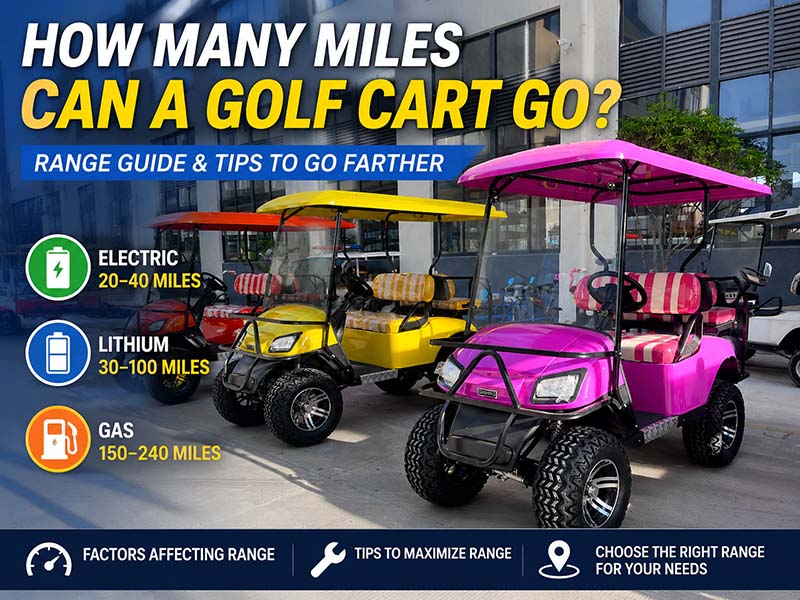
Simply put, the driving range of a golf cart varies significantly depending on its power system.
| Golf Cart Type | Average Driving Range |
| 36V Electric Golf Cart | 15–25 miles |
| 48V Electric Golf Cart | 20–40 miles |
| Lithium Battery Golf Cart | 30–100 miles |
| Gas-Powered Golf Cart | 150–240 miles |
For short-distance transportation within neighborhoods or communities, most electric golf carts provide more than enough range for daily use. However, for users who require all-day operation, gas-powered golf carts offer a clear advantage in terms of driving distance and convenience.
It is important to note that these figures represent average estimates only. Actual range can vary depending on several factors, including battery capacity, passenger and cargo weight, terrain conditions, weather, and driving habits.
How Many Miles Can an Electric Golf Cart Go?
Electric golf carts are the most common type on the market today and are especially popular among homeowners and community residents.
Their key advantages include:
- Low noise levels
- Low maintenance costs
- Comfortable driving experience
- Environmentally friendly with zero emissions
However, the actual driving range largely depends on the battery system installed.
Traditional Lead-Acid Battery Golf Carts
Many well-known golf cart brands still use lead-acid battery systems.
The most common configurations include:
- 36V systems
- 48V systems
Typical driving ranges are as follows:
| Battery System | Average Range |
| 36V Lead-Acid Battery | 15–25 miles |
| 48V Lead-Acid Battery | 20–40 miles |
For standard golf course use or neighborhood transportation, this range is generally sufficient for a full day of operation.
However, lead-acid batteries do have several drawbacks:
- Heavier weight
- Longer charging times
- Reduced lifespan after deep discharge cycles
- Noticeable range loss during cold winter weather
As a result, more and more golf cart owners are upgrading to lithium battery systems.
How Far Can a Lithium Golf Cart Go?
In recent years, lithium batteries have become one of the most important developments in the golf cart industry.
Compared with traditional lead-acid batteries, lithium batteries offer:
- Higher energy density
- Lighter weight
- Longer service life
- Faster charging speeds
Typical range performance is shown below:
| Battery Capacity | Average Range |
| 105Ah | 30–40 miles |
| 150Ah | 50–70 miles |
| 210Ah | 70–100 miles |
High-capacity lithium battery systems can even support more than a full day of continuous use for some applications.
For users who frequently travel longer distances, lithium-powered golf carts have become one of the most popular choices available.
How Many Miles Can a Gas Golf Cart Go?
When it comes to pure driving range, gas-powered golf carts remain the undisputed champion.
Most gas golf carts are equipped with:
- A 5–6 gallon fuel tank
- Single-cylinder or twin-cylinder engines
Average fuel efficiency is approximately:
30–40 MPG (miles per gallon)
Based on this efficiency, the estimated driving range is:
| Fuel Tank Capacity | Estimated Range |
| 5 Gallons | 150–200 miles |
| 6 Gallons | 180–240 miles |
Unlike electric golf carts that may require several hours of charging, gas-powered models can be refueled in just a few minutes, allowing users to get back on the road quickly.

Why do gas-powered vehicles offer a longer range?
The reason is quite simple.
Gasoline has a much higher energy density than batteries.
Consequently, gas-powered golf carts offer:
Longer range
Faster refueling
Greater suitability for all-weather operation
They are particularly well-suited for:
Farms
Ranches
Tourist attractions
Industrial parks
Outdoor hunting
Gas-powered models are often more convenient when continuous operation for several hours or more is required.
Factors That Affect the Range of a Golf Cart
Many consumers notice that even with the same model, actual driving range can vary by 20%–50% between different users.
The main reasons are as follows:
1. Battery Capacity
For electric golf carts, battery capacity is the most critical factor affecting range.
For example:
- 105Ah
- 150Ah
- 210Ah
The larger the capacity, the more electrical energy it can store, and therefore the longer the driving range.
This is the single most important factor affecting the range of an electric golf cart.
2. Passenger Load and Cargo Weight
The heavier the vehicle, the more energy the motor consumes.
Typically:
| Load Condition | Range Impact |
| Single driver | Standard range |
| Four passengers | 10%–20% reduction |
| Fully loaded with cargo | 20%–30% reduction |
If the cart is frequently carrying multiple passengers, a higher-capacity battery is recommended.
3. Terrain Conditions
Different road conditions significantly affect range:
- Flat roads: most energy-efficient
- Uphill roads: significantly higher energy consumption
- Grass: higher rolling resistance
- Sand: highest energy consumption
For example, the same golf cart may travel 40 miles on flat ground, but only 25–30 miles in hilly areas.
This is completely normal.
4. Tire Size
Many owners upgrade to:
- Off-road tires
- Larger wheels
- Lift kits
While these improve appearance and off-road capability, they also increase rolling resistance, resulting in:
- Higher energy consumption
- Slower acceleration
- Reduced range
Typically, this can reduce range by 5%–15%.
5. Driving Habits
Driving behavior also affects energy efficiency.
The following actions increase power consumption:
- Rapid acceleration
- Hard braking
- Long periods of high-speed driving
Smooth and steady driving can improve range by about 10%.
6. Weather and Temperature
Temperature is often overlooked, especially for lithium battery models.
When temperatures drop below 32°F (0°C):
- Battery activity decreases
- Output power is reduced
- Actual range decreases
In winter, range typically drops by:
- 10%
- 20%
- or even 30%
Therefore, users in colder regions should adjust their range expectations accordingly.
How many miles can a Street Legal Golf Cart go?
In recent years, more and more people have started purchasing Street Legal Golf Carts (LSVs).
These vehicles typically come equipped with:
- VIN number
- Seat belts
- Turn signals
- Rearview mirrors
- Brake lights
- LED lighting system
They are mainly used for community travel and short-distance road driving.
The typical driving range is:
| Type | Range |
| Standard LSV | 25–50 miles |
| Lithium LSV | 50–100 miles |
For daily community commuting, this range is already more than sufficient.
In fact, many residents in the United States drive less than 10 miles per day.
This means a single charge is often enough for several days of use.
How can you extend the driving range of a golf cart?
If you want your vehicle to travel further, consider the following measures:
Maintain the battery regularly
Adopt good charging habits:
Avoid leaving the battery in a low-charge state for extended periods.
Avoid deep discharges.
Use the original manufacturer’s charger.
Maintain proper tire pressure
Under-inflated tires increase rolling resistance.
This not only affects range but also accelerates tire wear.
Check tire pressure regularly against the manufacturer’s recommendations.
Reduce unnecessary weight
Remove items not in regular use:
Toolboxes
Heavy accessories
Excess cargo
A lighter vehicle achieves a longer range.
Drive smoothly
Avoid:
Sudden acceleration
Hard braking
Driving at full speed for extended periods
Good driving habits often matter more than you might think.
Upgrade to a lithium battery
For older lead-acid models, upgrading to a lithium battery system is often the most effective way to increase range.
Many users find that after upgrading:
Range increases by 30%–100%
Charging time is reduced
Battery lifespan doubles
It offers better long-term economic value.
How many miles can a golf cart travel in different usage scenarios?
| Usage Scenario | Recommended Range |
| Golf courses | 15–25 miles |
| Community transportation | 20–40 miles |
| Resorts | 30–50 miles |
| Campus transportation | 30–50 miles |
| Farms and ranches | 50–100 miles |
| Commercial operations | 60–100+ miles |
When purchasing, you should not focus only on maximum range. Instead, choose the configuration based on your actual usage needs.
There is no single universal answer to how far a golf cart can travel.
Overall:
- Traditional lead-acid electric golf carts: 15–40 miles
- Lithium battery golf carts: 30–100 miles
- Gas-powered golf carts: 150–240 miles
If the vehicle is mainly used for community transportation, golf courses, or family recreation, modern lithium golf carts are already sufficient for most users.
However, for farms, commercial facilities, and long-duration continuous operations, gas-powered golf carts still offer a clear advantage in range.
Choosing a model that fits your specific use case is far more important than simply pursuing the highest possible range.
FAQ
1. How many miles can a golf cart go on a full charge?
Most electric golf carts can travel between 20 and 40 miles on a full charge, while lithium battery models can reach 50 to 100 miles depending on battery capacity.
2. How many miles can a gas golf cart go on a full tank?
A gas golf cart typically travels between 150 and 240 miles on a full tank, depending on engine efficiency, terrain, and load.
3. What affects golf cart range the most?
Battery capacity, passenger weight, terrain, tire size, driving habits, and weather conditions are the biggest factors affecting golf cart range.
4. Do lithium golf carts go farther than lead-acid models?
Yes. Lithium-powered golf carts generally provide longer range, faster charging, lighter weight, and more consistent performance than lead-acid battery carts.
5. How can I make my golf cart go farther?
Maintain proper tire pressure, avoid overloading, drive smoothly, charge the battery regularly, and consider upgrading to a lithium battery system.
6. Is 40 miles of range enough for a golf cart?
For most community, resort, and neighborhood use, 40 miles of range is more than enough and can often last several days between charges.
7. Can a golf cart go 100 miles?
Yes. High-capacity lithium golf carts equipped with 150Ah–210Ah battery packs can achieve up to 100 miles under ideal driving conditions.