

As industrial parks, airports, tourist attractions, residential communities, factories, and large commercial complexes continue to demand higher operational efficiency, traditional gasoline-powered maintenance vehicles are gradually becoming unable to meet the modern maintenance teams’ needs for environmental protection, low operating costs, and high efficiency. In this context, Electric Utility Vehicles for Maintenance Teams are becoming an important choice for enterprises worldwide to upgrade their operation and maintenance systems.
As a professional electric vehicle manufacturer, ODREAMCAR is committed to providing global customers with high-performance, multifunctional, and customizable Electric Utility Vehicle for Industrial Use solutions, helping maintenance teams improve work efficiency, reduce operating costs, and achieve a greener and more sustainable management model.
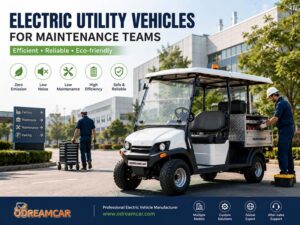
What Are Electric Utility Vehicles for Maintenance Teams?
Electric Utility Vehicles are low-speed electric vehicles specifically designed for short-distance transport, equipment maintenance, inspections, and logistical support. Compared to traditional fuel-powered vehicles, they offer distinct advantages—such as zero emissions, low noise levels, and reduced maintenance costs—making them ideally suited for use within large campuses and on private internal roadways.
Maintenance teams typically require frequent movement between various work zones while simultaneously transporting tools, spare parts, and repair equipment. Traditional methods are not only inefficient but also characterized by high fuel consumption and excessive noise. Electric maintenance utility vehicles, however, effectively resolve these issues.
Modern electric maintenance vehicles are now widely utilized in a variety of sectors:
Factory Equipment Maintenance
Campus Logistics and Operations
Hospital Facility Management
Airport Ground Support Services
Hotel and Resort Maintenance
Municipal Engineering Maintenance
Warehousing and Logistics Parks
Photovoltaic Power Station Inspections
Mining Site Equipment Repair
Many international maintenance and operations fleets have already begun adopting electric solutions to lower long-term operating costs and enhance their environmental profile.

Key Advantages of Electric Utility Vehicles
1. Significantly Reduced Operating Costs
Compared to traditional fuel-powered maintenance vehicles, one of the greatest advantages of electric vehicles is their lower cost of ownership.
Electric vehicles do not require:
Oil changes
Spark plug replacements
Fuel filter replacements
Complex engine maintenance
Due to the simple structure of electric motors—which contain far fewer moving parts than internal combustion engines—maintenance frequency is significantly reduced. Industry research indicates that maintenance costs for electric vehicles can be lowered by approximately 40%.
For large-scale factories, campuses, or property management companies, a maintenance fleet comprising dozens of vehicles can generate substantial annual savings on fuel and maintenance expenses.
2. Ideal for High-Frequency, Short-Distance Operations
The typical operational characteristics of maintenance teams include:
Frequent starts
Short-distance travel
Multiple stops
Low-speed operation
Fuel-powered vehicles, however, are not particularly efficient under these specific operating conditions.
Electric Utility Vehicles are perfectly suited for this work model:
Faster acceleration response
Stronger low-speed torque
Zero fuel consumption while idling (when stopped)
Greater energy efficiency during frequent start-and-stop cycles
This enables maintenance personnel to complete inspection and repair tasks with greater efficiency.
3. Eco-Friendly and Low-Noise Operation
In environments such as hospitals, campuses, hotels, and airports, noise control is of paramount importance.
Electric maintenance vehicles operate quietly, ensuring minimal disruption to:
Guest rest periods
Student classes
Hospital environments
Visitor experiences in scenic areas
Furthermore, their zero-tailpipe-emission status aligns with the trend of increasingly stringent environmental regulations.
For businesses, the adoption of electric vehicles also serves to enhance their ESG profile and elevate their standards of green operations.
4. Enhanced Efficiency for Maintenance Teams
ODREAMCAR electric utility vehicles support a wide range of functional configurations, including:
Toolbox systems
Rear cargo beds
Tool racks/mounts
Foldable storage compartments
Engineering warning lights
Inspection lighting systems
GPS fleet management
Rain-proof canopies
Enclosed cabins
This allows maintenance personnel to transport a larger volume of equipment in a single trip, thereby reducing time spent on back-and-forth transit.
For large-scale campuses, this translates into:
Faster response times for repair tasks
Higher efficiency in routine inspections
Reduced waste of human resources
Lower costs associated with vehicle dispatch and scheduling
Product Features of ODREAMCAR Electric Utility Vehicles
As a professional manufacturer, ODREAMCAR’s 2 Seater Utility Golf Cart with Carriage is specially optimized to meet the working needs of maintenance teams.
High Load Capacity
Maintenance work frequently requires the transportation of:
Tools and equipment
Cables
Spare parts
Cleaning equipment
Repair materials
ODREAMCAR models feature a high-strength chassis design capable of handling the heavy-duty loads required for daily operations.
Extended Range Design
For large campuses and industrial complexes, driving range is a critical factor.
ODREAMCAR offers:
Lead-acid battery versions
Lithium-ion battery versions
High-performance lithium-ion models support longer patrol and maintenance shifts, thereby reducing the frequency of recharging.
Wide Range of Models Available
Different maintenance teams have distinct requirements; therefore, ODREAMCAR offers a variety of options, including:
2-seater maintenance vehicles
4-seater utility vehicles
Models with cargo beds
Models with enclosed cabins
Custom-engineered vehicles
Patrol vehicles
Engineering and repair vehicles
Customers may also request OEM/ODM customization tailored to their specific project requirements.
Enhanced Safety Features
Maintenance teams often operate in complex environments, making vehicle safety of paramount importance.
ODREAMCAR electric vehicles feature:
Anti-slip systems
High-brightness LED lighting
Reverse warning alarms
Seatbelts
Engineering warning lights
Reinforced braking systems
Selected models also feature a hill-hold function to prevent rollback on inclines, further enhancing safety in challenging terrain.
Typical Applications for Electric Utility Vehicles
Factory Maintenance Teams
Large-scale manufacturing plants typically cover vast areas, requiring maintenance personnel to travel between multiple workshops on a daily basis.
Electric maintenance vehicles help to:
Rapidly transport repair tools
Accelerate equipment response times
Reduce internal logistics burdens
Airports and Transportation Hubs
Ground maintenance operations at airports involve:
Equipment inspections
Lighting repairs
Runway support
Baggage system maintenance
Many airports have begun adopting electric maintenance vehicles to lower carbon emissions and reduce operating costs.
Hotels and Resorts
High-end resort complexes typically have strict requirements regarding noise levels and environmental sustainability.
Electric utility vehicles are capable of:
Operating quietly
Providing rapid maintenance response
Minimizing disruption to the guest experience
Consequently, their adoption is becoming increasingly widespread across scenic sites and resort hotels worldwide.
Campuses and Hospitals
Campuses and hospitals require:
A quiet environment
Efficient logistics support
Eco-friendly operations
Electric maintenance vehicles are well-equipped to meet these specific needs; as a result, procurement volumes for these vehicles have seen continuous growth in recent years.
Why are more and more companies choosing electric maintenance vehicles?
With the development of global new energy trends, companies are increasingly focused on:
Operating costs
Carbon emissions
Fleet management efficiency
Sustainable development
Compared with traditional fuel-powered vehicles, Electric Utility Vehicles offer significant advantages:
| Comparison Item | Electric Maintenance Vehicle | Fuel Maintenance Vehicle |
| Energy cost | Low | High |
| Noise | Extremely low | Relatively high |
| Exhaust emissions | Zero | Yes |
| Maintenance frequency | Low | High |
| Start/stop efficiency | High | Average |
| Campus/park adaptability | Strong | Average |
This is also an important reason why more and more maintenance teams are shifting toward electrification.
ODREAMCAR Empowers Global Maintenance Teams with Upgraded Solutions
As a specialized manufacturer of electric vehicles, ODREAMCAR consistently provides global clients with high-quality solutions in Electric Utility Vehicles.
We offer:
OEM/ODM Services
A Wide Range of Vehicle Configurations
Customized Feature Development
Global Export Expertise
Stable Component Supply
Professional After-Sales Support
Whether for industrial parks, airports, campuses, or property management teams, ODREAMCAR is able to provide tailored electric maintenance vehicle solutions that meet the specific operational needs of each client.
As the global trend toward green operations continues to gain momentum, Electric Utility Vehicles for Maintenance Teams are poised to become a key direction in future operations and maintenance management. Choosing high-quality, reliable electric maintenance vehicles not only enhances team efficiency but also helps enterprises establish a modern operational framework that is more eco-friendly, intelligent, and efficient.
FAQ
1. What are electric utility vehicles used for?
Electric utility vehicles are used for maintenance, inspection, transportation of tools, facility management, and support operations in factories, campuses, airports, resorts, and industrial parks.
2. Why choose electric utility vehicles over gasoline vehicles?
Electric utility vehicles offer lower operating costs, reduced maintenance, zero emissions, quieter operation, and better efficiency for short-distance and frequent-stop tasks.
3. Can ODREAMCAR utility vehicles be customized?
Yes. ODREAMCAR provides OEM and ODM customization services, including cargo boxes, enclosed cabins, tool racks, warning lights, battery options, and seating configurations.
4. What battery options are available?
ODREAMCAR offers both lead-acid battery and lithium battery options depending on customer requirements, working hours, and project budgets.
5. Are electric utility vehicles suitable for large industrial areas?
Yes. ODREAMCAR electric utility vehicles are designed for factories, warehouses, industrial parks, airports, and large campuses with reliable range and strong carrying capacity.
6. How long does it take to charge the vehicle?
Charging time depends on the battery type and capacity. Most models can be fully charged within 6–8 hours, while lithium versions may charge faster.
7. What maintenance is required for electric utility vehicles?
Compared with gasoline vehicles, electric utility vehicles require less maintenance because they do not need oil changes, fuel system servicing, or engine repairs.
8. Does ODREAMCAR support global export and after-sales service?
Yes. ODREAMCAR supports worldwide export, technical support, spare parts supply, and professional after-sales service for international customers.