
Electric Golf Cart Selection and Solution Guide for Residential Communities
In modern residential communities, internal transportation is gradually upgrading from traditional walking and fuel-powered vehicles to electric, low-speed, and intelligent systems. Especially in large residential areas, villa districts, and gated communities, providing residents, property management, and security personnel with efficient and safe transportation options has become crucial for project operation.
Therefore, choosing a suitable Golf Cart for Community is not merely purchasing a vehicle, but a vital decision in building a community transportation system.
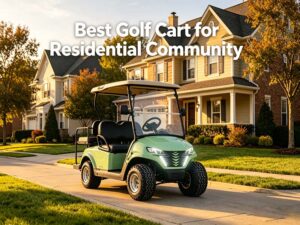
What is the ideal golf cart for a residential community?
Unlike golf course vehicles, community vehicles have more specific requirements: High-frequency use (daily operation) Multiple application scenarios (pickup/patrol/transportation) Higher safety standards Lower operating costs
Therefore, the “Best Golf Cart” is not necessarily the most expensive, but rather the configuration best suited for a community setting.

Recommended Golf Cart Configuration for Residential Communities
Based on extensive project experience, we recommend the following standard configuration:
| Parameter | Recommended Configuration |
| Seating Capacity | 4-seat electric golf cart or 6-seater electric golf cart |
| Battery | Lithium battery (long range, long lifespan) |
| Speed | ≤ 25 km/h (safety priority) |
| Standard Features | Roof canopy + rain curtains + LED lighting |
| Optional Features | Rearview camera / Bluetooth / Custom logo |
Why is this configuration recommended?
4/6 seats are the optimal solution.
Meets daily pick-up and drop-off needs.
Balances cost and efficiency.
Suitable for most community sizes.
Lithium batteries are superior to lead-acid batteries.
Longer lifespan (3-5 times longer).
Faster charging.
Lower maintenance costs.
Safe speed of 25km/h.
Complies with community traffic flow.
Reduces accident risk.
How to choose a car for different community scenarios?
A community typically uses a combination of vehicles, not just one type. 👇
1. Resident Shuttle Service (Core Need)
Recommended Model:
4-seater / 6-seater Electric Golf Cart
Application Scenarios:
Community Entrance → Building
Parking Lot → Unit Entrance
Benefits:
✔ Improves living experience
✔ Reduces walking fatigue
2. Security Patrol Vehicle
Recommended Model:
2-seater or 4-seater Patrol Golf Cart
Configuration Suggestions:
Warning Lights
Amplifier
Long-range Battery
Benefits:
✔ Improves patrol efficiency
✔ Enhances community security
3. Property Management Transport Vehicle
Recommended Model:
2-Seater Utility Golf Cart with Carriage
Application Scenarios:
Tool Transport
Gardening Material Transport
Garbage Collection
Benefits:
✔ Replaces tricycles
✔ Improves property management efficiency
4. High-End Community Concierge Vehicle
Recommended Model:
Customized High-End Electric Golf Cart
Upgraded Configurations:
Leather Seats
Customized Body Color
Brand Logo
Benefits:
✔ Enhances community prestige
✔ Enhance customer experience
Why should residential communities use electric golf carts?
Safety is far superior to traditional vehicles.
Low-speed design.
Stable braking.
Unobstructed visibility.
Lower operating costs.
Compared to gasoline vehicles:
No fuel costs.
Simple maintenance.
Low failure rate.
Long-term cost savings of 30%–50%.
Better suited to the community environment.
No noise pollution.
No exhaust pollution.
In line with green community trends.
Improves property management services.
Provides shuttle services.
Enhances resident satisfaction.
Creates a high-end community image.
How to determine if a supplier is professional?
Many customers easily fall into the trap of focusing only on price and ignoring system capabilities.
When choosing a supplier, focus on the following:
✅ Does the supplier provide a complete solution?
Beyond simply selling vehicles, can they provide:
Vehicle quantity planning
Route design suggestions
Usage scenario matching
✅ Does the supplier support customization?
Including:
Number of seats
Exterior color
Brand logo
✅ Does the supplier have export experience?
Especially for overseas projects:
Voltage compatibility
High temperature/humidity environment adaptability
International transportation experience
✅ Does the supplier control long-term costs?
A truly professional supplier will help you reduce:
Battery replacement costs
Repair costs
Downtime losses
What Makes the Best Golf Cart?
In summary, the best golf cart for residential communities should possess:
✔ 4–6 seat configuration
✔ Lithium battery system
✔ Safe low-speed design
✔ Versatile adaptability
✔ Customizable and scalable
It’s not a single product, but a complete community transportation solution.
Get your community golf cart solution now!
If you are planning a residential community project or looking to upgrade your existing community transportation system:
We can provide you with:
Free selection advice
Community vehicle configuration solutions
Customized design support
Worldwide shipping
Making your community more efficient, safer, and more valuable.
FAQ – Best Golf Cart for Residential Community
1. What is the best golf cart for a residential community?
The best choice is typically a 4-seater or 6-seater electric golf cart with a lithium battery, offering the ideal balance of capacity, efficiency, and long-term cost savings.
2. Why are electric golf carts suitable for residential communities?
They provide quiet, zero-emission transportation with enhanced safety due to low-speed operation, making them ideal for residential environments.
3. How do I choose the right golf cart for my community?
Consider community size, usage scenarios (transport, patrol, or maintenance), seating capacity, and battery type to ensure optimal performance.
4. Are lithium battery golf carts better than lead-acid models?
Yes, lithium batteries offer longer lifespan, faster charging, lighter weight, and lower maintenance costs compared to lead-acid batteries.
5. Can golf carts be customized for community projects?
Yes, they can be customized with different seating options, colors, branding, and additional features to match specific project requirements.