
Best Electric Utility Vehicle Solution for Industrial Applications
In modern industrial facilities, whether factories, warehouses, logistics parks, or large production bases, efficient internal transportation systems have become a key factor in improving operational efficiency. Traditional methods relying on manual handling or fuel-powered vehicles are not only inefficient but also costly and polluting.
With technological advancements, Electric Utility Vehicles are becoming the new standard solution in the industrial sector. Compared to traditional vehicles, they are more environmentally friendly, quieter, and have lower maintenance costs, and are being adopted by an increasing number of companies.
If you are looking for a complete solution, you can check out Electric Utility Vehicle for Industrial Us:
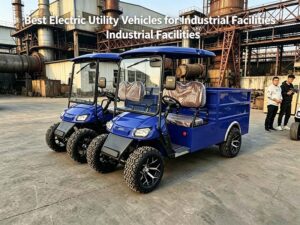
What is an Electric Utility Vehicle (EUV)?
An Electric Utility Vehicle (EUV) is a multi-functional vehicle designed specifically for industrial environments, primarily used for:
Personnel transport
Material handling
Tool transport
Equipment maintenance support
It is typically battery-powered (lead-acid or lithium-ion), enabling safe operation in enclosed or semi-enclosed environments without producing exhaust emissions.
Essentially, it is a crucial transport tool bridging manual handling and heavy equipment (such as forklifts).

Why are electric transport vehicles increasingly being chosen for industrial applications?
1. Zero emissions, better suited for indoor use: Electric vehicles produce no exhaust fumes, making them ideal for enclosed spaces such as warehouses and workshops, effectively improving air quality.
2. Lower operating costs: Electricity costs are significantly lower than fuel costs.
No maintenance required, such as oiling or filters.
Lower failure rate.
Significantly lower overall operating costs.
3. Low noise, improving work environment comfort: Electric transport vehicles operate almost silently, helping to improve the work environment and reduce fatigue.
4. Increased work efficiency: In large factories or industrial parks:
Employee mobility increases by 2-3 times.
Material transport is more efficient.
Manual handling is reduced.
5. Multi-functional applications, one vehicle for multiple uses:
Electric transport vehicles can be used for:
Production workshop logistics
Warehousing and distribution
Equipment maintenance
Security patrol
One vehicle can cover multiple scenarios.
Main Types of Industrial Electric Transport Vehicles
1. Passenger Carrier
Suitable for employee commuting, inspections, etc.
Common: 4-seater / 6-seater
2. Utility Cargo Vehicle
Equipped with a rear cargo box for transporting vehicles and materials.
Most commonly used in industrial settings.
3. Multi-functional Hybrid Vehicle
Capable of carrying both passengers and cargo.
Suitable for maintenance and engineering teams.
How to Choose the Right Electric Transport Vehicle for Industrial Projects?
1. Prioritize Usage Scenarios
Logistics Transportation → Choose a vehicle with a cargo box
Personnel Commuting → Choose a multi-seat model
Combined Use → Choose a hybrid model
2. Load Capacity
Industrial environments typically require:
≥300kg (basic)
≥500kg (recommended)
3. Battery Selection
Lead-acid: Low cost
Lithium-ion: Long lifespan, fast charging
Strongly recommended for industrial projects: Lithium-ion
4. Range
General recommendations:
Small to medium-sized factories: 40–60km
Large industrial parks: 60–100km
5. Customization Capability (Critical)
Industrial customers often require:
Thickened chassis
Larger cargo box
Tool racks/shelves
Rainproof/enclosed design
Standard models often cannot meet these requirements.
ODREAMCAR Industrial Electric Vehicle Recommendations
Based on industrial applications, we recommend the following configurations:
Factory General Use: 2-Seater Utility Golf Cart with Carriage
Suitable for: Maintenance, logistics, equipment transport
Features: Large rear-mounted cargo box
Flexible and compact, suitable for narrow aisles
High cost-effectiveness
Comprehensive Efficiency: 4-Seater Cargo Utility Golf Buggy
Suitable for: Maintenance teams, inspections
Advantages: Simultaneous passenger and cargo transport
Improved team efficiency
Reduced vehicle count
Large Park Use: 6-Seater Electric Golf Cart
Suitable for: Factories, parks, airports
Features: High passenger capacity
Suitable for fixed-route shuttles
Industrial Project Selection Comparison
| Parameter | 2 Seater Utility Golf Cart with Cargo | 4 Seater Cargo Utility Golf Buggy | 6 Seater Electric Golf Cart |
| Function | Cargo transport | Passenger + cargo | Passenger transport |
| Application | Warehouse / Maintenance | Factory / Inspection | Industrial park / Commuting |
| Load Capacity | High | Medium to high | Medium |
| Maneuverability | High | High | Medium |
| Efficiency | High | Very high | High |
Why are smaller manufacturers a better fit for industrial clients?
Many clients initially consider large brands, but in actual industrial projects:
1. Greater Customization Flexibility
We can customize to your needs:
Dimensions
Load Capacity
Features
2. Faster Response to Project Needs
24-hour Quote
Small-batch Production Available
Quick Solution Adjustments
3. Higher Cost-Effectiveness
Factory Direct Supply, No Brand Premium
4. Better Understanding of Real-World Use Cases
We serve:
The Real Needs of Factories/Construction Sites/Warehouses
Not Standardized Retail Products
Electrification of Industrial Transportation
With increasingly stringent environmental policies and corporate ESG requirements, electrification has become a trend:
Stricter emission regulations
Higher energy costs
Smarter factory management
More and more industrial companies are shifting from gasoline-powered vehicles to electric transportation systems.
For industrial facilities, electric transport vehicles are not just “replacement tools,” but also:
Key equipment for improving efficiency + reducing costs + achieving green operations
✔ Small factories → 2-seat trucks
✔ Medium-sized factories → 4-seat + cargo box
✔ Large industrial parks → 6-seat shuttle trucks
If you are planning an industrial transportation solution:
We recommend prioritizing:
High efficiency + Customizability + Low cost + Direct factory supply
FAQ – Electric Utility Vehicles for Industrial Facilities
1. What are electric utility vehicles used for in industrial facilities?
Electric utility vehicles are used for transporting materials, tools, and personnel within industrial environments such as factories, warehouses, and logistics parks. They improve efficiency and reduce manual labor.
2. Are electric utility vehicles suitable for indoor use?
Yes, electric utility vehicles are ideal for indoor use because they produce zero emissions and operate quietly, making them safe for warehouses and production areas.
3. What is the typical load capacity of an electric utility vehicle?
Most electric utility vehicles have a load capacity ranging from 300 kg to over 500 kg, depending on the model and configuration.
4. What battery is best for industrial electric vehicles?
Lithium batteries are the preferred choice due to their longer lifespan, faster charging, and lower maintenance compared to lead-acid batteries.
5. Can electric utility vehicles be customized for industrial use?
Yes, they can be customized with cargo boxes, tool racks, enclosed cabins, heavy-duty suspensions, and other features to meet specific industrial requirements.
6. Why choose a factory-direct supplier for electric utility vehicles?
Factory-direct suppliers offer better pricing, flexible customization, faster response times, and lower minimum order quantities, making them ideal for industrial projects.