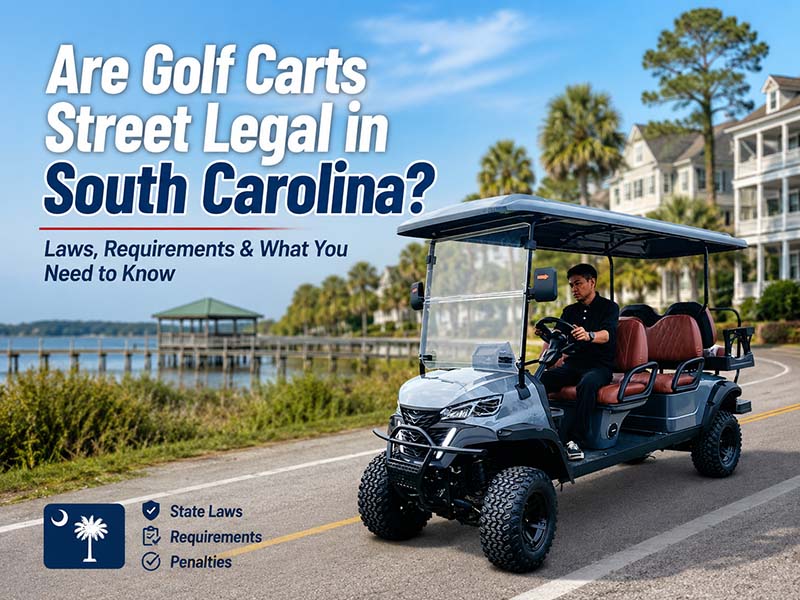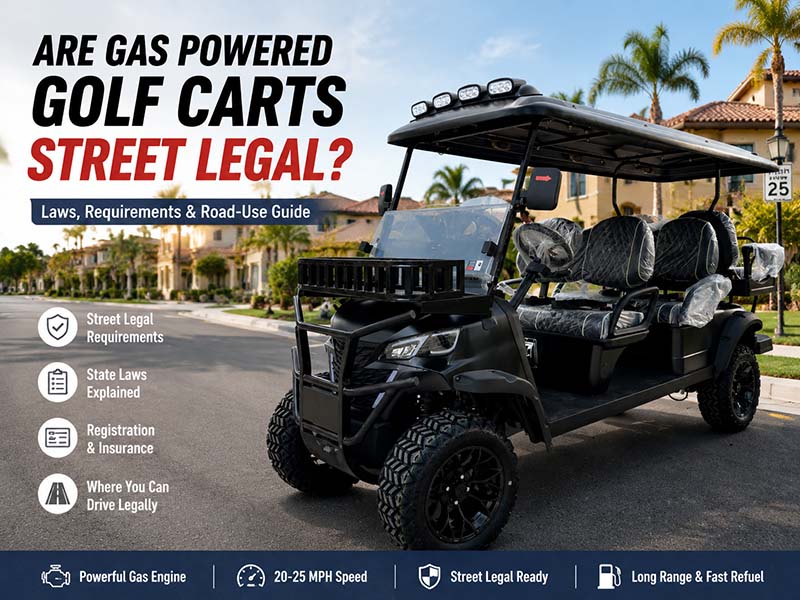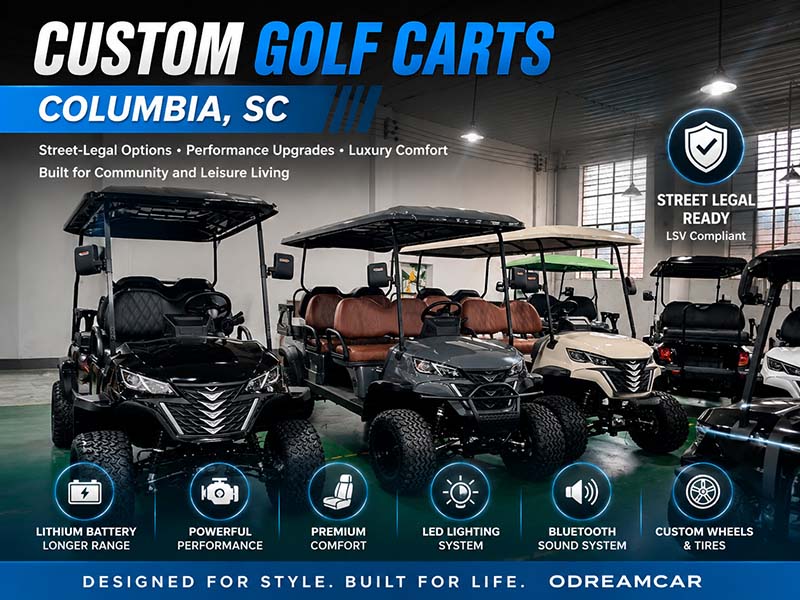

As community transportation needs increase, golf carts are no longer merely vehicles for navigating golf courses. In many U.S. states, golf carts have gradually expanded their presence into residential communities, resorts, private properties, and even certain public roads. South Carolina is no exception; however, to legally operate on public roads, golf carts must meet a specific set of regulatory requirements. In previous articles—such as “Are golf carts street legal in Georgia?“, “Are golf carts street legal in Michigan?“, “Are golf carts street legal in California?“, and “Are golf carts street legal in Texas?“—ODREAMCAR has explored the street legality of golf carts in various states. This article will provide a detailed analysis of golf cart street legality in South Carolina, along with key considerations for owners and operators.
Overview of Golf Cart Regulations in South Carolina
In South Carolina, the law distinguishes between standard Golf Carts, Low-Speed Vehicles (LSVs), and Street-Legal Golf Carts.
Standard Golf Carts: Designed for use on golf courses or private property, these vehicles typically have a top speed of less than 20 mph. They are not permitted to operate on public roads and do not require registration or license plates.
Low-Speed Vehicles (LSVs): These are four-wheeled electric or gas-powered vehicles capable of speeds between 20 and 25 mph. They are permitted to operate on certain public roads but must comply with specific safety equipment standards.
Street-Legal Golf Carts: These typically consist of standard golf carts that have been modified—or are factory-configured as LSVs—to meet state laws regarding safety and registration requirements, thereby allowing them to operate on specific public roads.
South Carolina permits the operation of these vehicles on roads with a posted speed limit of 35 mph or less; however, highways and busy main thoroughfares typically prohibit golf cart traffic.

Basic Requirements for Street-Legal Golf Carts
To legally operate a golf cart on the roads in South Carolina, the following conditions must be met:
1. Vehicle Equipment Requirements
According to South Carolina law, a street-legal golf cart must be equipped with the following features:
Headlights, taillights, and brake lights
Turn signals (front and rear)
Side mirrors (left and right; a rearview mirror may also be required in some cases)
Seat belts
Horn
VIN (Vehicle Identification Number) and a valid registration license plate
These features ensure the vehicle can operate safely on public roads while complying with state traffic regulations.
2. Speed Requirements
The maximum speed of an LSV (Low-Speed Vehicle)—or street-legal golf cart—must fall within the range of 20 to 25 mph.
Standard golf carts, which typically travel at speeds below 20 mph, are not eligible for street-legal use.
3. Registration and Insurance
Street-legal golf carts must be registered with the South Carolina DMV, and a license plate must be obtained.
Minimum automobile liability insurance coverage is required to ensure the safety of both the driver and others.
4. Driving Requirements
The driver must possess a valid driver’s license (typically a standard automobile license).
Minors wishing to drive must meet the age requirements and licensing conditions stipulated by state law.
5. Road Restrictions
Operation is restricted to roads with a posted speed limit of 35 mph or less.
When driving at night, it must be ensured that all lighting equipment is fully functional.
Operation is prohibited on highways or major arterial roads with heavy traffic.
Common Misconceptions
Can I hit the road just by installing lights?
Many vehicle owners assume that simply installing headlights, taillights, or a horn is sufficient to legally drive on public roads. However, South Carolina law requires vehicles to be registered, possess a VIN, carry insurance, and meet specific LSV (Low-Speed Vehicle) standards; merely installing lights does not fulfill the requirements for road use.
Are golf carts permitted on all community roads?
Not all community roads allow golf carts. Highways, roads with heavy traffic, or areas explicitly prohibited by state law remain off-limits.
Can a standard golf cart be made street-legal simply by modifying it?
While modifications can enhance safety, the vehicle must still comply with LSV regulations, as well as registration and insurance requirements, to be considered street-legal.
Purchase and Modification Recommendations
Selecting a Street-Legal Golf Cart:
Before purchasing, verify whether the vehicle was originally manufactured as an LSV (Low-Speed Vehicle) or if it can be upgraded to meet street-legal specifications.
Modification Considerations:
Lighting, brakes, and seatbelts must comply with South Carolina state regulations.
Avoid modifications that result in excessive speed or overpowered performance.
When upgrading batteries, ensure that the vehicle’s weight distribution and balance remain safe.
Modifying or purchasing a street-legal golf cart not only allows for legal road use but also enhances the driving experience and overall safety.
Legal Consequences
Operating a golf cart on public roads without meeting street-legal requirements may result in the following consequences:
Fines or traffic violation citations.
Vehicle impoundment.
Invalidation of insurance coverage, leaving the owner personally liable for any accidents.
Therefore, compliance with the law is not merely a safety requirement; it is also an essential measure for avoiding legal risks.
In South Carolina, golf carts may legally be operated on public roads, provided that the vehicle meets street-legal or LSV standards, is properly registered, and is covered by insurance. Standard golf carts remain restricted to use on private property or within designated communities. When purchasing, modifying, or operating a golf cart, owners must carefully familiarize themselves with state laws and road restrictions to ensure that both safety and legal compliance are maintained.
FAQ
Q1: Do golf carts in South Carolina require a license plate?
A1: Yes, street-legal golf carts must be registered with the DMV and obtain a license plate.
Q2: Are standard golf carts permitted on public roads?
A2: No; standard golf carts are restricted to use on private property or within private communities.
Q3: Is it permissible to drive a golf cart at night?
A3: Yes, provided that the vehicle is equipped with functional headlights, taillights, brake lights, and reflectors.
Q4: What precautions should be taken when driving a modified golf cart on the road?
A4: Modifications must comply with South Carolina’s LSV (Low-Speed Vehicle) standards; you must install safety equipment, register the vehicle, and obtain insurance coverage.