
Why is the demand for gas powered golf carts increasing?
In recent years, search interest in Gas powered golf carts for sale has continued to rise, indicating a clear shift in market demand. Golf carts are no longer limited to golf courses; they are gradually expanding into broader applications such as residential communities, hotels, farms, and industrial parks.
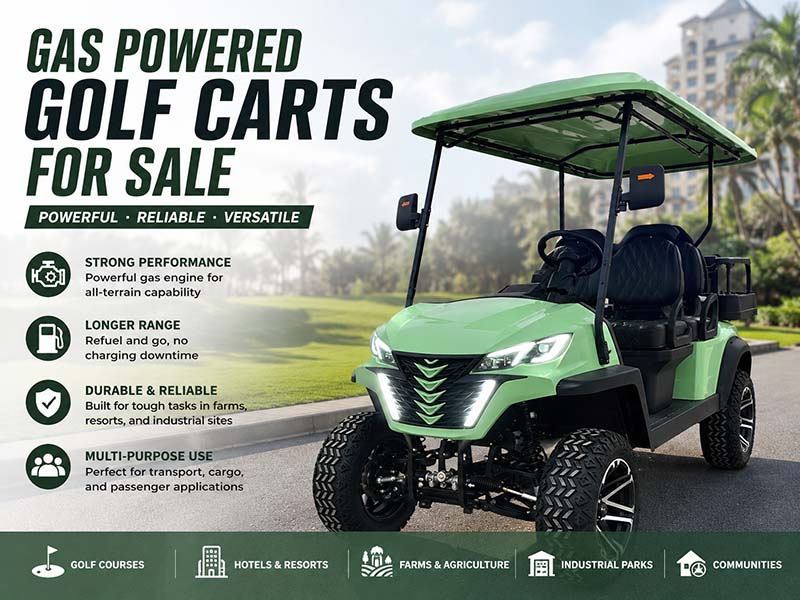
Compared with traditional electric models, the biggest advantage of gas powered golf carts lies in their continuous power output and independence from charging infrastructure, making them especially suitable for long-distance and high-frequency usage scenarios.
At the same time, with the growing demand for customization, more users are focusing on multi-purpose vehicle applications such as shuttle transportation, cargo handling, and passenger transport.
In large hotels and resorts, golf carts have even become standard equipment for internal shuttle services, such as Golf Cart for Hotel Luggage Transport, significantly improving operational efficiency.

What is a gas-powered golf cart?
A gas-powered golf cart is a low-speed vehicle powered by a small gasoline engine, typically used for short-distance transport and various operational tasks.
Its core components include:
A small gasoline engine
A mechanical transmission system
A chassis and suspension system
An operating control system (throttle, brakes, and gear shifting)
Unlike electric golf carts, it does not rely on battery charging but runs on gasoline, making it better suited for environments requiring continuous operation.
Key Advantages of Gas-Powered Golf Carts
1. Superior Range
Gas-powered models can continue operating simply by refueling; they are not limited by charging times, making them ideal for scenarios requiring prolonged, continuous use.
2. Stable Power Output
Gas engines deliver consistent power performance when navigating slopes, carrying heavy loads, or traversing complex terrain.
3. High Operational Flexibility
There is no need to locate charging stations, making them suitable for complex environments such as farms, construction sites, and large residential communities.
4. Suitable for Multi-Purpose Transport
They are well-suited for tasks such as transporting luggage within hotels, patrolling large complexes, and moving equipment.

Disadvantages of Gas Powered Golf Carts
Although gas powered models offer many advantages, they also have some limitations:
Relatively higher noise levels
Require regular maintenance (engine oil, filters, etc.)
Produce emissions, making them less suitable for fully eco-friendly environments
Long-term operating costs may be higher than electric models
Therefore, in some gated communities, more users prefer Electric Golf Carts for Gated Communities to achieve a quieter and more environmentally friendly driving experience.
Gas Powered Golf Carts for Sale Type Classification
1. Brand new fuel golf cart
Directly supplied from the factory, it supports a variety of configuration options, including the number of seats, lighting systems, tire specifications, etc.
2. Used fuel golf carts
The price is lower and suitable for users with limited budget, but they need to focus on checking the engine status and maintenance records.
3. Custom fuel golf cart
Can be customized according to usage, such as:
Heightened chassis (off-road type)
Multi-seater version (4-seater/6-seater)
Cargo type rear bucket structure
Strengthen suspension system
Application Scenario Analysis
Gas powered golf carts are suitable for a wide range of industry applications:
1. Golf Courses
Used as basic transportation vehicles, suitable for moving players and equipment across the course.
2. Hotels and Resorts
Used for guest transportation and luggage handling, such as Golf Cart for Hotel Luggage Transport, improving overall service efficiency.
3. Farms and Agricultural Transport
Used for carrying farming tools, crops, and transporting workers across large farmland areas.
4. Industrial Parks and Warehousing
Used for short-distance logistics transportation, improving internal operational efficiency and material flow.
5. Communities and Property Management
Used for patrol, maintenance, and daily facility inspection tasks.
What should you consider when buying a gas-powered golf cart?
When selecting a gas-powered golf cart, focus on the following factors:
1. Engine brand and performance
A high-quality engine directly impacts service life and operational stability.
2. Chassis structural strength
The use of a reinforced steel structure determines load-bearing capacity.
3. Maintenance and parts availability
Ease of obtaining replacement parts is crucial.
4. Suitability for the operating environment
Different settings require different configurations (e.g., off-road, urban, or campus use).
5. Fuel consumption and operating costs
Long-term operating costs should be evaluated in advance.
Comparison of Gas vs Electric Golf Carts
| Item | Gas Powered Golf Cart | Electric Golf Cart |
| Power | Strong | Moderate |
| Range | Unlimited with refueling | Depends on charging |
| Noise | Higher | Quiet |
| Environmental Impact | Average | Excellent |
| Maintenance | Higher | Lower |
| Application Scenarios | Outdoor / Industrial use | Communities / Hotels |
Reference Price Range
The price of gas-powered golf carts is typically influenced by the following factors:
Brand
Engine specifications
Seating capacity
Customization level
General price ranges:
Entry-level: $3,000 – $4,000
Mid-range: $4,000 – $7,000
High-end/Custom: $7,000+
Where can you buy gas-powered golf carts?
Primary purchasing channels include:
Factory-direct sales (best value for money)
Local dealerships
Online platforms
Custom manufacturers (supporting OEM/ODM)
Manufacturers like ODREAMCAR, for example, typically offer:
Dual-system models (gas and electric)
Custom multi-seat versions
Solutions for hotels, residential communities, and industrial sites
Bulk purchasing support
Why choose factory-direct supply?
The advantages of buying directly from the manufacturer are clear:
Lower costs
Support for extensive customization
Better pricing on bulk orders
Reliable after-sales service and spare parts availability
For hotel and property management projects, this approach can significantly reduce long-term operating costs.
Gas-powered golf carts continue to hold a significant position in the market thanks to their powerful performance, long range, and versatility across various environments. They remain indispensable tools, particularly for farms, industrial parks, and hotel transport systems.
If your operations involve frequent transport, heavy loads, or extended running times, a gas-powered golf cart is an excellent option to consider.
FAQ
1. Are gas-powered golf carts better than electric ones?
It depends on the use case: gas models are better suited for outdoor work and long-duration operations, while electric models are ideal for residential communities and hotels.
2. What is the lifespan of a gas-powered golf cart?
With proper use and maintenance, they can last 8–12 years.
3. How much maintenance do gas-powered golf carts require?
They require regular replacement of engine oil, filters, and spark plugs.
4. Can golf carts be driven on public roads?
Some models meet LSV (Low-Speed Vehicle) standards and are permitted for use on specific roads.
5. Which environments are best suited for gas-powered golf carts?
Farms, industrial parks, large resorts, and long-distance transport scenarios are the most suitable applications.