
In recent years, golf carts have evolved beyond being mere means of transport on golf courses. Across numerous communities, resort areas, farms, and campuses throughout the United States, golf carts have become an essential mode of transportation for daily travel.
As user demands for extended range and enhanced power performance have risen, an increasing number of consumers are turning their attention to gas-powered golf carts. Compared to their Electric Golf Cart, gas models offer a longer driving range, faster refueling times, and superior hill-climbing capabilities; consequently, they continue to enjoy steady market demand in certain regions.
However, this trend has given rise to a common question:
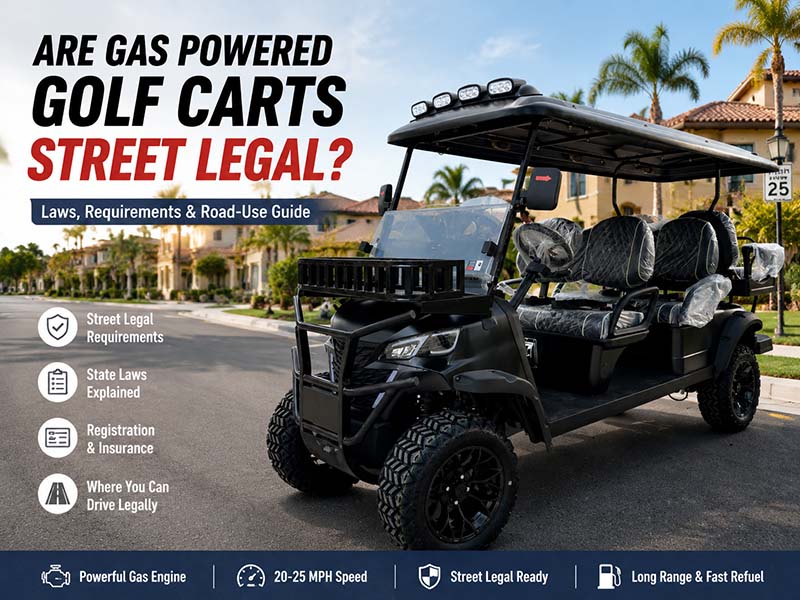
Are gas-powered golf carts street legal?
The answer is not a simple “Yes” or “No.”
In reality, whether a gas-powered golf cart can legally be driven on public roads depends primarily on whether the vehicle complies with local regulatory requirements and if it is equipped with the necessary “street-legal” features.
This article provides a comprehensive breakdown of the regulations governing the use of gas-powered golf carts on public roads, the requirements for vehicle modifications, and practical advice for prospective buyers.
What is a Gas-Powered Golf Cart?
A gas-powered golf cart refers to a golf cart driven by a gasoline engine.
The fuel-powered models currently common on the market typically feature:
A 4-stroke gasoline engine
Power output ranging from approximately 9 HP to 15 HP
An automatic transmission system
Rear-wheel drive
Compared to electric golf carts, fuel-powered models offer the following advantages:
Longer Range
A standard gas-powered golf cart can typically travel over 100 miles on a single tank of fuel.
Faster Refueling
There is no need to wait hours for charging; refueling takes just a few minutes.
Greater Power
For challenging terrain—such as inclines, farms, or scenic areas—fuel-powered models generally possess superior capability to navigate complex conditions.
Wide Range of Applications
Commonly found in:
Golf courses
Resorts
Residential communities
Farms and ranches
Industrial parks
Campus transportation

Can standard gas-powered golf carts be driven directly on public roads?
In most states:
Standard gas golf carts typically cannot be driven directly on public roads.
The reason is quite simple.
Traditional golf carts were originally designed for the following purposes:
Transportation within golf courses
Use on private property
Short-distance travel within gated communities
Consequently, many models were not designed to meet standard motor vehicle regulations.
They typically lack the following key features:
Headlights
Taillights
Brake lights
Turn signals
Rear-view mirrors
Seatbelts
Windshields
A Vehicle Identification Number (VIN)
Because they fail to meet road safety requirements, most states prohibit standard gas golf carts from being driven directly on public roads.
Difference Between Gas Golf Cart and Street Legal Golf Cart
Many users mistakenly believe that gas-powered golf carts cannot be legally driven on public roads. In fact, this is not the case.
The real difference lies in whether the vehicle qualifies as a Street Legal Golf Cart.
| Item | Standard Gas Golf Cart | Street Legal Gas Golf Cart |
| Power System | Gasoline | Gasoline |
| Top Speed | 15–20 mph | 20–25 mph |
| Headlights | None | Required |
| Taillights | None | Required |
| Brake Lights | None | Required |
| Turn Signals | None | Required |
| Rearview Mirrors | None | Required |
| Seat Belts | Usually None | Required |
| Windshield | Optional | Usually Required |
| VIN | None | Required |
| Registration | Not allowed | Required |
| Public Road Use | Restricted | Allowed |
In short:
Gas power itself is not the limitation for road use. The key factor is whether the vehicle meets Street Legal standards.
What Equipment Is Required for a Gas-Powered Golf Cart to Be Street-Legal?
To qualify a gas-powered golf cart for legal street use, it typically needs to be equipped with the following items:
1. Headlights
To ensure safe operation during nighttime or in low-visibility conditions.
2. Taillights
To enhance visibility and allow vehicles behind to easily identify the cart.
3. Brake Lights
To alert drivers of following vehicles that the cart is slowing down.
4. Turn Signals
To signal intentions when changing lanes or making turns.
5. Mirrors
Typically includes:
Driver-side mirror
Left-side mirror
Right-side mirror
6. Seat Belts
Most states designate seat belts as a mandatory requirement for street-legal vehicles.
7. Windshield
Some states require the installation of a DOT-certified windshield.
8. VIN (Vehicle Identification Number)
Required for vehicle registration and insurance applications.
Vehicles lacking a VIN typically cannot be legally registered.
What do U.S. federal regulations stipulate?
In the United States, street-legal golf carts are typically regulated as Low-Speed Vehicles (LSVs).
LSVs are required to comply with federal motor vehicle safety standards:
FMVSS 500
According to these regulations:
The maximum speed must be between 20 and 25 mph.
The vehicle must be equipped with specific safety features.
The vehicle must undergo and complete certification.
Once these requirements are met, the vehicle can be registered as an LSV.
Upon obtaining a legal license plate, the vehicle is authorized to operate on designated roadways.
Which States Allow Gas-Powered Golf Carts on the Road?
In previous posts, we have addressed the questions: “Are golf carts street legal in Georgia?“, “Are golf carts street legal in Michigan?“, “Are golf carts street legal in California?“, and “Are golf carts street legal in Texas?“.
In reality, regulations regarding golf carts vary significantly from state to state across the U.S. To learn the specific policies and statutes for various states, please refer to our past articles and future updates; in this article, we will provide a brief overview.
The following states have relatively lenient regulations:
Florida
One of the states with the most widespread use of golf carts in the U.S.
Permitted on certain roads with speed limits of 35 mph or less.
South Carolina
Home to numerous golf communities.
Golf carts are legally permitted on the road in certain areas.
Georgia
Many communities allow golf carts to be used as a mode of transportation for short-distance travel.
Texas
Certain cities and communities allow gas-powered golf carts on designated roads.
Arizona
Has a relatively mature regulatory framework for Low-Speed Vehicles (LSVs).
The requirements for legal street use are clearly defined.
Important Note:
Even within the same state, different cities may have different regulations.
Therefore, it is always best to consult the local DMV and municipal ordinances before traveling.
Is a driver’s license required to operate a gas-powered golf cart?
The answer depends on the specific usage scenario.
Private Property
Generally, a driver’s license is not required.
Examples include:
Farms
Private estates
Golf courses
Gated Communities
Some areas permit minors to operate these vehicles.
However, age restrictions typically apply.
Street-Legal Golf Carts
If the vehicle has been registered as an LSV (Low-Speed Vehicle):
The following are typically required:
A valid driver’s license
Vehicle registration plates
Proof of insurance
These requirements are essentially identical to those for standard motor vehicles.
Do gas-powered golf carts require insurance?
For standard golf carts:
Insurance coverage is typically not mandatory.
However, purchasing liability insurance is recommended.
This is because the potential costs of accident-related compensation can far exceed the cost of the insurance itself.
For “Street Legal” models:
Most states require:
Liability Insurance
(Also known as third-party liability coverage).
Additionally, it is recommended to purchase:
Collision Coverage
Comprehensive Coverage
To provide more comprehensive protection for the vehicle.
Can a gas-powered golf cart be modified to be “Street Legal”?
This is a question of primary concern for many owners.
The answer is:
Yes—though not all models are suitable for such modifications.
Common modifications include:
Front and rear lighting systems
Turn signals
Horn
Rearview mirrors
Seatbelts
DOT-certified windshield
VIN certification
Once the modifications are complete, you will also need to:
Undergo a state inspection
Register the vehicle
Purchase insurance
Only after successfully completing all of these steps can the vehicle be legally driven on public roads.
Pros and Cons of Gas-Powered Golf Carts
Advantages
Extended Range
No need for frequent recharging.
Rapid Refueling
Can be fully refueled in just a few minutes.
Superior Power Performance
Better suited for hilly terrain and heavy-duty applications.
Suitable for All-Weather Operation
Offers distinct advantages in scenic areas, farms, and commercial settings.
Disadvantages
Higher Noise Levels
Engine operation generates noticeable noise.
Higher Emissions
Less environmentally friendly compared to electric vehicles.
Higher Maintenance Costs
Requires:
Oil changes
Spark plug replacements
Carburetor cleaning
Restricted Use in Certain Communities
Some eco-conscious communities prefer electric models.
What Should You Consider When Buying a Street-Legal Gas Golf Cart?
If you are planning to purchase a gas-powered golf cart that is legal for road use, we recommend focusing on the following key points:
Does it have a VIN?
Vehicles without a VIN typically cannot be registered.
Does it comply with FMVSS 500?
This is a crucial prerequisite for being street-legal.
Is it eligible for registration and licensing?
Confirm this with the seller before making a purchase.
Is it equipped with complete safety features?
These include:
Lighting systems
Seat belts
Rear-view mirrors
A windshield
Are certification documents provided?
Reputable manufacturers typically provide:
Certificates of Compliance
VIN documentation
Supporting materials for registration
So, Are Gas-Powered Golf Carts Street-Legal?
The answer is:
Standard gas-powered golf carts typically cannot be driven directly on public roads; however, once they have undergone legal certification and meet “Street-Legal” or LSV (Low-Speed Vehicle) standards, they can be legally operated on designated public roads in many states.
The key factor determining legality is not the vehicle’s power source, but rather whether it complies with applicable road safety regulations.
If you plan to purchase or modify a gas-powered golf cart, we recommend familiarizing yourself in advance with the relevant regulations in your specific state and local municipality. This ensures that the vehicle’s configuration, registration, and insurance coverage all meet the necessary requirements, allowing you to travel safely and legally.
FAQ
1. Are gas powered golf carts street legal?
Standard gas golf carts are usually not street legal. However, if they meet LSV requirements and local regulations, they can be legally driven on certain public roads.
2. Can a gas golf cart be registered?
Yes. A gas golf cart that complies with federal and state requirements, including VIN and safety equipment, can often be registered as a low-speed vehicle.
3. Do gas golf carts need insurance?
Regular golf carts may not require insurance, but street legal gas golf carts usually need liability insurance and registration.
4. Can I drive a gas golf cart on public roads?
Only if local laws allow it and the vehicle meets all street legal requirements, including lights, mirrors, seat belts, and registration.
5. Is a gas golf cart better than an electric golf cart?
Gas golf carts offer longer range and faster refueling, while electric golf carts are quieter, cleaner, and require less routine maintenance.
6. Can I make my gas golf cart street legal?
In many states, yes. You may need to install safety equipment, obtain a VIN, pass inspections, register the vehicle, and purchase insurance.
7. What speed does a street legal gas golf cart need to reach?
Most street legal golf carts classified as LSVs must be capable of traveling between 20 and 25 mph.
8. Do you need a driver’s license to operate a street legal gas golf cart?
Yes. In most states, a valid driver’s license is required to drive a registered street legal golf cart on public roads.