

The power core of a golf cart is its battery system; whether utilizing lead-acid or lithium-ion technology, the condition of the battery directly impacts the vehicle’s driving range, power output, and safety. Many users encounter issues during operation—such as sluggish starting, reduced driving range, or charging anomalies—at which point battery testing becomes essential.
As a professional golf cart manufacturer, ODREAMCAR is here to provide you with a detailed guide on how to scientifically assess the health of your golf cart battery, helping you quickly determine whether it requires maintenance or replacement.
Why Test Golf Cart Batteries?
Batteries are consumables that gradually age with use. If not tested regularly, the following issues may arise:
Significantly reduced driving range
Insufficient vehicle power
Increased charging times
Battery overheating or swelling
Sudden power failure
Regular battery testing helps you:
Identify faulty batteries in advance
Prevent a decline in overall vehicle performance
Extend the battery’s overall lifespan
Reduce maintenance costs

Common Methods for Testing Golf Cart Batteries
Battery testing typically falls into four categories, each suited to different situations.
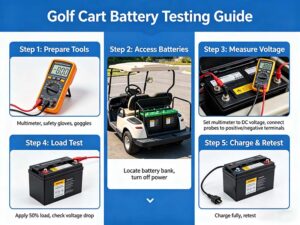
Method 1: Voltage Testing (The Most Basic Method)
This is the most frequently used diagnostic method and requires the use of a multimeter.
Procedure:
Turn off the golf cart’s power supply.
Open the battery compartment.
Use a multimeter to measure the voltage of each individual battery.
Record the voltage reading for each battery.
Normal Reference Values (for Lead-Acid Batteries):
6V Battery: Typically 6.3V – 6.5V
12V Battery: Typically 12.6V – 12.8V
Diagnostic Criteria:
Voltage significantly below standard → Battery is aging or damaged.
Large voltage discrepancies between individual batteries → Battery pack is unbalanced.
Voltage appears normal but driving range is poor → Possible capacity degradation.
Method 2: Load Testing (More Accurate)
Load testing simulates actual operating conditions and provides a more accurate assessment than simple voltage testing alone.
Procedure:
Use a professional battery load tester.
Apply a simulated load to the battery.
Observe the voltage drop under load.
Diagnostic Criteria:
Voltage drops steadily → Battery is in good condition.
Voltage drops rapidly → Battery lacks sufficient capacity.
A specific battery cell experiences a severe voltage drop → That individual cell is damaged.
Method 3: Specific Gravity Testing (Applicable Only to Lead-Acid Batteries)
Lead-acid batteries contain an internal electrolyte; their condition can be determined by measuring the specific gravity of this fluid.
Tools:
Electrolyte Hydrometer
Procedure:
Remove the battery cell caps.
Draw a small sample of the electrolyte fluid.
Measure the specific gravity reading.
Standard Range:
1.265 – 1.280 → Normal
Below 1.225 → Battery is undercharged or aging.
Large discrepancies between individual cells → Battery pack is unbalanced.
Method 4: Charge-Discharge Testing (The Most Comprehensive Method)
This method provides the most realistic assessment of actual battery performance.
Procedure:
Fully charge the battery pack.
Operate the golf cart under normal driving conditions.
Record the driving time and distance covered.
Compare the results against the standard driving range.
Diagnostic Criteria:
Driving range has decreased by more than 30% → Battery is aging.
Power output feels noticeably weaker → Insufficient capacity.
Battery charge indicator is unstable/fluctuating → Battery fault.
How Do You Test a Lithium Battery?
If your golf cart is powered by a lithium battery, the testing procedure differs slightly.
1. Testing via the BMS
Lithium batteries typically come equipped with a BMS (Battery Management System), which allows you to directly monitor:
Voltage
Current
Temperature
Remaining Charge Level
2. Voltage Consistency Check
The critical factor for lithium batteries is “balance”:
Minimal voltage variation between individual cells → Normal
Significant variation → Battery pack is abnormal
3. Charging Efficiency Test
Observe the following:
Does it charge to full capacity quickly?
Does it lose charge too rapidly?
Is the charging process interrupted?
Common Issues During Battery Testing
1. Why is the voltage normal, yet the vehicle cannot travel very far?
Possible Causes:
Battery capacity degradation
Increased internal resistance
Battery aging
2. Why does a single battery affect the entire vehicle?
Because golf cart batteries are configured in a series arrangement:
👉 A single weak battery will drag down the entire system.
3. Is it possible to replace just one battery?
Theoretically yes, but it is not recommended:
New and old batteries are mismatched
This leads to an overall imbalance
It is recommended to replace the entire set or replace them in pairs.
How do you determine if a battery needs to be replaced?
Replacement is recommended in the following situations:
Battery life has decreased by more than 30%.
The battery drains rapidly shortly after charging.
The battery is bulging or leaking.
The voltage of an individual battery cell is abnormal.
Charging time has become abnormally long.
How to Extend Golf Cart Battery Lifespan?
1. Charge Regularly
Do not wait until the battery is completely depleted before recharging.
2. Avoid Over-Discharging
Deep discharge can severely reduce battery lifespan.
3. Keep Clean and Dry
Prevent:
Corrosion
Short circuits
Poor electrical contact
4. Use the Original Charger
Avoid damage caused by voltage mismatches.
5. Perform Regular Equalization Charging (for Lead-Acid Batteries)
Maintain the consistency of the battery pack.
For more details, please refer to our “Golf Cart Maintenance Guide.”
ODREAMCAR Battery System Advantages
As a professional manufacturer of golf carts, ODREAMCAR possesses distinct advantages in battery system design:
1. Intelligent Battery Management System (BMS)
Real-time monitoring of:
Voltage
Temperature
Current
2. High-Consistency Battery Packs
Strictly matched prior to leaving the factory to minimize imbalance issues.
3. Supports Dual Battery Options: Lead-Acid and Lithium-Ion
Catering to diverse budgets and operational scenarios.
4. Optimized Energy Consumption System
Enhances driving range and extends battery lifespan.
Testing a golf cart battery is not a complex task, provided the correct methods are employed. Through voltage testing, load testing, specific gravity testing, and actual driving tests, one can comprehensively assess the health status of the battery.
Regular inspections not only help prevent sudden malfunctions but also significantly extend battery lifespan, thereby enhancing the overall user experience of the vehicle.
Is your golf cart frequently plagued by issues such as reduced range, insufficient power, charging anomalies, or battery degradation? Perhaps it is time to upgrade to a new electric golf cart that offers more stable performance and lower maintenance costs.
As a professional golf cart manufacturer, ODREAMCAR is dedicated to providing customers worldwide with high-quality electric golf carts and customized solutions. Our models feature high-efficiency battery systems, reliable controllers, and durable chassis designs, ensuring extended range, robust power, and a worry-free user experience.
We offer a diverse selection of models—including 2 seater electric golf cart, 4 seat electric golf cart, and 6 seater electric golf cart options—along with OEM branding customization, factory-direct pricing, and global shipping services, allowing you to acquire superior products at a more cost-effective price point. Whether for golf courses, resorts, hotel shuttles, community transportation, or commercial operations, we can provide the ideal solution to meet your specific needs.
Contact us today to receive a personalized quote and exclusive offers, making the upgrade of your operations smoother and more efficient than ever before.
FAQ
Q1: How do I test golf cart batteries?
A: You can test golf cart batteries using a multimeter to check voltage, a load tester to simulate real driving conditions, or a hydrometer for lead-acid batteries to measure electrolyte specific gravity.
Q2: What voltage should a fully charged golf cart battery have?
A: A fully charged 6V battery should read about 6.3–6.5V, and a 12V battery should read about 12.6–12.8V.
Q3: How do I know if my golf cart battery is bad?
A: Signs include low or inconsistent voltage, rapid power loss, reduced driving range, slow acceleration, or one battery performing worse than others in the pack.
Q4: Can I test golf cart batteries without special tools?
A: Basic testing can be done by observing performance (range and power), but accurate diagnosis requires a multimeter or battery tester.
Q5: How often should golf cart batteries be tested?
A: It is recommended to test batteries every 2–3 months or whenever you notice reduced performance or charging issues.