
With the widespread adoption of golf carts in settings such as residential communities, scenic spots, hotels, industrial campuses, and private estates, vehicle maintenance has become increasingly important. A properly maintained golf cart not only extends the vehicle’s service life but also reduces repair costs while enhancing safety and the overall daily user experience.
Whether you have purchased a golf cart for family transportation, shuttle services at a scenic attraction, or commercial operations, regular maintenance is the key to ensuring stable and reliable performance. As a professional golf cart manufacturer, ODRAMCAR has compiled this practical *Golf Cart Maintenance Guide* to help you easily master the essential maintenance procedures.
Why Do Golf Carts Require Regular Maintenance?
Many users assume that, due to their simple construction, golf carts do not require specialized maintenance. In reality, however—whether they are Electric Golf Cart or Gas Golf Cart models—prolonged use inevitably leads to issues such as battery degradation, tire wear, aging brake components, and loose electrical connections.
Regular maintenance offers the following benefits:
Extends the vehicle’s service life
Maintains consistent range and performance
Enhances driving safety
Minimizes unexpected breakdowns and downtime
Reduces long-term repair costs
Preserves the vehicle’s appearance and brand image
This is particularly critical for commercial clients—such as scenic attractions, hotels, and property management companies—as any vehicle downtime can disrupt normal operations; consequently, preventive maintenance is of paramount importance.

Battery Maintenance: The Core Component of Your Vehicle
The battery is one of the most critical components of an electric golf cart, directly determining both driving range and power performance.
1. Lead-Acid Battery Maintenance
If your vehicle is equipped with a lead-acid battery, please observe the following:
Regularly check the electrolyte levels.
Use distilled water to top up fluid levels; avoid using tap water.
Keep the battery surface clean and dry.
Avoid storing the battery in a discharged state for extended periods.
Recharge the battery promptly after every use.
If the vehicle remains unused for a prolonged period, it is recommended to perform a supplementary charge once a month.
2. Lithium Battery Maintenance
Maintenance for lithium batteries is simpler, though the following practices are still recommended:
Use only the original, manufacturer-matched charger.
Avoid charging in high-temperature environments or under direct sunlight.
Recharge the battery promptly when the charge level drops below 20%.
Maintain a charge level between 50% and 70% during long-term storage.
Regularly check the status of the Battery Management System (BMS).
ODRAMCAR recommends that commercial clients prioritize lithium-battery models, as they can significantly reduce maintenance workload.
Tire and Suspension System Inspection
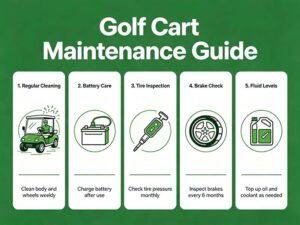
Tires directly impact driving stability and comfort; therefore, they should be inspected once a month.
Key inspection points:
Is the tire pressure normal?
Are there any cracks, bulges, or punctures?
Is the tread wear excessive?
Is the wear on the left and right tires even?
If the vehicle is frequently driven under a full load or on challenging road surfaces, the inspection frequency should be increased.
Additionally, check the suspension system for the following issues:
Unusual noises
Loose components
Softened shock absorption
Drifting or pulling to one side while driving
If any issues are detected, they should be repaired promptly to ensure driving safety and handling integrity.
Brake System Maintenance: Do Not Overlook
Although golf carts do not travel at high speeds, their braking systems remain critical to safety.
It is recommended to perform the following checks every three months:
Brake pad wear levels
Brake fluid levels
Whether braking distance has increased
Whether the brake pedal feels excessively soft
Whether the parking brake functions correctly
If the vehicle is operated in hilly terrain, on scenic routes, or in environments involving frequent passenger transport, the inspection interval should be shortened.
Should any abnormal braking noises or a reduction in braking force be detected, the vehicle must be taken out of service immediately for inspection and repair.
Routine Cleaning and Exterior Maintenance
Keeping your vehicle clean is not only aesthetically pleasing but also helps extend the lifespan of the vehicle body.
Recommended Cleaning Methods:
Wipe down the vehicle body using a pH-neutral detergent.
Rinse with clean water and dry immediately thereafter.
Clean seats using a soft cloth.
Avoid using highly corrosive cleaning agents on the dashboard.
Promptly remove mud and grit from the undercarriage after rain.
Important Considerations:
Do not use a high-pressure water sprayer to directly rinse the electronic control systems.
Avoid prolonged exposure to direct sunlight outdoors.
It is recommended to use a car cover for protection when parking.
For commercial vehicles—such as those used by hotels or tourist attractions—maintaining a clean and tidy appearance also serves to enhance the customer experience.
Periodic Inspection of Electrical Systems
Modern golf carts are commonly equipped with various electronic components—such as lighting systems, instrument panels, USB ports, and backup cameras—making regular inspection of the electrical wiring essential.
It is recommended to perform the following checks every six months:
Check for signs of aging in the power wiring harness.
Verify that all connectors and plugs are secure and not loose.
Ensure that all lighting systems are functioning correctly.
Confirm that the horn is in proper working order.
Check the instrument panel display for any anomalies.
If the vehicle is frequently operated in humid environments, particular attention should be paid to waterproofing and the potential for wiring corrosion.
How to Maintain a Vehicle During Long-Term Storage?
If the vehicle is to be parked for more than one month, the following measures are recommended:
Electric Models:
Charge the battery to 50%–70%.
Turn off the main power switch.
Park in a cool, dry location.
Recharge the battery once a month.
Fuel-Powered Models:
Drain old fuel or add a fuel stabilizer.
Start the vehicle and run the engine periodically.
Check the condition of the engine oil.
Additionally, it is recommended to lift the vehicle to take the weight off the tires, or to move the vehicle periodically, to prevent localized tire deformation.
Establish a Maintenance Schedule
The most effective method for standardizing maintenance is to establish a fixed service cycle.
Daily Checks:
Battery Charge Level
Brakes
Lights
Exterior Damage
Monthly Checks:
Tire Pressure
Battery Condition
Screws and Fasteners
Cleaning and Upkeep
Quarterly Checks:
Braking System
Suspension System
Steering System
Annual Comprehensive Service:
Electrical Control System Diagnostics
Battery Capacity Testing
Comprehensive Chassis Inspection
Replacement of Worn Parts
Why Choose After-Sales Service from a Specialized Manufacturer?
Many malfunctions do not stem from issues with the parts themselves, but rather from misdiagnoses resulting from a lack of professional inspection.
By choosing a manufacturer like ODRAMCAR, you gain access to:
Genuine OEM Parts Support
Expert Technical Guidance
Rapid Fault Diagnosis
Battery System Maintenance Advice
Customized Operational & Maintenance Plans
For customers making bulk purchases, we also offer long-term after-sales support partnerships.
Golf cart maintenance need not be complicated, yet regular upkeep is crucial. Whether for private home use or commercial operations, prioritizing the care of the battery, tires, brakes, electrical systems, and general cleanliness ensures the vehicle remains in excellent condition for the long term.
ODRAMCAR is dedicated to providing our customers with high-quality golf carts and comprehensive after-sales support. If you require maintenance advice, spare parts, or upgrade solutions for new models, please feel free to contact us at any time.
FAQ
Q1: How often should a golf cart be serviced?
A: Basic inspections should be done monthly, while a full maintenance check is recommended every 6 to 12 months depending on usage frequency.
Q2: How can I make my golf cart battery last longer?
A: Charge it regularly, avoid deep discharge, use the correct charger, and store the cart in a cool, dry place.
Q3: How do I know if my golf cart tires need replacement?
A: Replace tires if you notice worn tread, cracks, uneven wear, punctures, or reduced driving stability.
Q4: Why are my golf cart brakes making noise?
A: Brake noise may be caused by worn brake pads, dirt buildup, loose parts, or the need for adjustment.
Q5: Can I wash my golf cart with water?
A: Yes, but avoid spraying water directly onto batteries, controllers, chargers, and sensitive electrical components.
Q6: What should I do if my golf cart will not be used for a long time?
A: Charge the battery to about 50%–70%, turn off the power, store it indoors, and recharge periodically.
Q7: Does ODRAMCAR provide maintenance support?
A: Yes. ODRAMCAR offers technical guidance, spare parts support, and professional after-sales service for customers worldwide.