
Driven by growing environmental awareness and advancements in electric mobility, electric golf carts are gaining increasing favor among golf courses, residential communities, and private households. Compared to traditional gas-powered carts, electric models offer quieter operation, zero emissions, and simpler handling. However, a primary concern for many prospective buyers is: “How long do electric golf carts last?” In our previous article, we addressed the question: “How long do batteries last in electric golf carts?” In this article, we will provide a comprehensive breakdown of this topic, examining factors such as the overall vehicle lifespan, battery longevity, key components, usage habits, and maintenance tips.
Average Lifespan of Electric Golf Carts
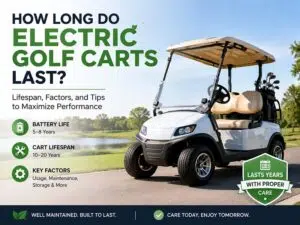
Generally speaking, the overall lifespan of an electric golf cart ranges from 8 to 15 years, depending on usage frequency and maintenance practices.
Home or Light Use: If used solely for short-distance trips or local community transportation on a daily basis, both the vehicle body and the battery can typically last for over 12 years.
Golf Course or Commercial Use: Due to prolonged daily operation, the overall lifespan of the vehicle is likely to be around 8 to 10 years.
The lifespan of electric golf carts also varies across different brands. Taking ODREAMCAR as an example, models equipped with high-performance motors and durable aluminum alloy bodies typically have a service life exceeding 10 years, provided they undergo proper maintenance.

Battery Lifespan
The battery is the most critical component of an electric golf cart; its lifespan directly impacts the overall service life of the vehicle. Batteries are typically categorized into two types: lead-acid and lithium. Battery lifespan was discussed in detail in a previous article, so this article will not elaborate extensively on the subject.
Lead-acid Battery
Average Lifespan: 4–6 years
Advantages: Low cost, simple maintenance
Disadvantages: Heavy weight; deep discharge can damage the battery; relatively short cycle life
Lithium Battery
Average Lifespan: 8–10 years
Advantages: Lightweight; long cycle life; fast charging speed
Disadvantages: Higher initial cost, though more cost-effective over the long term
The primary factors influencing battery lifespan include:
Charging Habits: Avoid overcharging or leaving the battery in a fully discharged state for extended periods.
Depth of Discharge: Do not allow the battery to discharge completely until its power is fully depleted.
Environmental Temperature: Both excessive heat and extreme cold can accelerate battery aging.
Usage Frequency: Frequent charging and discharging cycles will shorten the battery’s lifespan.
Lifespan of Key Components in Electric Golf Carts
Aside from the battery, the lifespan of other key components within the vehicle also influences its overall service life:
Motor: Typically lasts 10–15 years.
Controller: Has an estimated lifespan of 8–12 years.
Suspension System, Brake System, and Tires: These are consumable parts that require periodic inspection and replacement.
Regular maintenance of these components can significantly extend the vehicle’s overall lifespan and prevent major malfunctions during operation.
The Impact of Usage Habits and Environment on Lifespan
The lifespan of an electric golf cart depends not only on manufacturing quality but is also closely tied to usage habits and environmental factors:
Charging Practices: It is recommended to charge the vehicle promptly after daily use; avoid allowing the battery to undergo deep discharge or remain uncharged for extended periods.
Driving Conditions: Driving on flat roads places minimal strain on the motor and suspension system, whereas rough terrain or slippery surfaces will accelerate wear and tear.
Climatic Conditions: Environments characterized by high temperatures or high humidity can negatively impact the performance of the battery and motor.
Storage Environment: Whenever possible, store the vehicle in a dry, shaded location to avoid exposure to rain, snow, or direct sunlight.
Tips for Extending the Lifespan of an Electric Golf Cart
Proper Charging and Battery Maintenance: Use the original manufacturer’s charger and avoid overcharging.
Regular Inspection of Key Components: Periodically check the motor, controller, braking system, and tires.
Cleaning and Corrosion Prevention: Regularly wash the vehicle body and chassis to prevent rust and corrosion.
Avoid Overloading and Speeding: Maintaining a reasonable load and controlling driving speed helps reduce the strain on the motor.
Seasonal Storage Precautions: If the vehicle is to remain unused for an extended period, keep the battery charge level between 50% and 70%, and recharge it periodically.
In summary, the overall lifespan of an electric golf cart typically ranges from 8 to 15 years, while the battery lifespan varies between 4 and 10 years, depending on the battery type. Proper usage and regular maintenance are the keys to extending the vehicle’s lifespan. For users seeking long-term utility and excellent value for money, opting for a model equipped with a lithium-ion battery—combined with diligent daily maintenance—represents the ideal solution.
FAQ
Q1: Can the battery be replaced if it fails?
A: Yes. Both lead-acid and lithium batteries can be replaced individually, preventing the need to scrap the entire vehicle.
Q2: How much longer can a used electric golf cart be used?
A: This depends on its age and the condition of the battery; generally, it can still be used for another 3 to 7 years.
Q3: Which is the better investment: lead-acid or lithium batteries?
A: For short-term use, lead-acid batteries offer lower upfront costs; for long-term use, lithium batteries provide a longer lifespan and offer better overall value.