
When purchasing or using a golf cart, one of the primary concerns for many users is: How long do 48-volt golf cart batteries last? Specifically, users want to know exactly how many years of service life they can expect, how far the cart can travel on a single charge, and how to extend the battery’s overall lifespan.
The 48-volt system is currently one of the most prevalent voltage configurations in the golf cart market, widely utilized in community transport vehicles, golf course carts, scenic area shuttles, and property patrol vehicles. Striking an optimal balance between power performance, driving range, and cost-effectiveness, this system enjoys popularity among users worldwide.
As a professional golf cart manufacturer, ODRAMCAR offers a comprehensive analysis of the actual service life of 48-volt golf cart batteries, covering key aspects such as battery types, life cycles, influencing factors, and maintenance techniques.
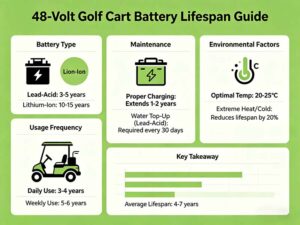
How long does a 48-volt golf cart battery typically last?
The lifespan of a 48-volt golf cart battery depends primarily on the type of battery used.
1. Lead-Acid Battery Lifespan
Traditional 48-volt lead-acid battery systems typically consist of either six 8-volt batteries or eight 6-volt batteries.
Under normal usage conditions:
Expected service life: approximately 3–5 years
Cycle life: approximately 500–800 cycles
For commercial vehicles subject to frequent weekly use, the lifespan may be shorter.
However, with proper maintenance, some users are able to extend the battery’s service life to over 5 years.
2. Lithium Battery Lifespan
Nowadays, an increasing number of 48-volt golf carts are adopting lithium battery systems.
Under normal conditions:
Expected service life: approximately 8–12 years
Cycle life: capable of exceeding 3,000 cycles
Maintenance requirements: extremely low
Consequently, when considering long-term costs, lithium batteries often offer a distinct advantage.

How far can it travel on a single charge?
In addition to service life, users are also concerned about the driving range per charge.
The range of a 48-volt golf cart typically depends on the following factors:
Battery capacity (Ah)
Number of passengers
Terrain gradient
Driving speed
Tire condition
Ambient temperature
General Reference Ranges:
48V Lead-Acid Systems:
Approximate range per charge: 25–45 km
48V Lithium-Ion Systems:
Approximate range per charge: 40–80 km
High-capacity lithium-ion systems can achieve even greater distances.
The Top 5 Factors Affecting 48-Volt Battery Lifespan
Many batteries fail prematurely—not due to manufacturing defects, but rather due to improper usage.
1. Charging Habits
Incorrect habits include:
Leaving the battery uncharged for extended periods after it has been fully depleted
Overcharging
Using an incompatible charger
Best practices:
Charge the battery promptly after use
Use the original manufacturer’s charger or a certified alternative
Maintain a regular charging schedule
2. Depth of Discharge
Completely draining the battery during each cycle accelerates its aging process.
Recommendations:
Recharge the battery promptly when its charge level drops below 20%–30%
Avoid prolonged periods of deep discharge
3. Environmental Temperature
Both high and low temperatures can negatively impact battery lifespan.
Impact of High Temperatures:
Accelerates the aging of battery cells
Reduces overall capacity
Impact of Low Temperatures:
Temporarily reduces driving range
Decreases charging efficiency
The optimal storage temperature typically ranges from 15°C to 25°C.
4. Usage Frequency
Vehicles used in commercial operations—which undergo high-frequency, daily use—typically have a shorter battery lifespan compared to vehicles used for personal or household purposes.
Examples:
Occasional household use: Results in a longer battery lifespan
All-day operation (e.g., tourist shuttle services): Leads to faster wear and tear
5. Overall Vehicle Condition
Issues such as underinflated tires, dragging brakes, or worn-out bearings increase the load on the battery, thereby reducing both driving range and overall lifespan. For specific usage and maintenance guidelines, please refer to our “Golf Cart Maintenance Guide”.
How do you determine if a 48-volt battery needs to be replaced?
If any of the following conditions occur, it may indicate that the battery has entered a state of decline:
Common Indicators:
Significantly reduced range after a full charge
Lack of power when climbing inclines
Abnormally long or short charging times
Severe overheating of the battery
Significant voltage fluctuations
Sudden power loss in the vehicle
For lead-acid batteries, if the battery has been in use for more than four years and its range has noticeably diminished, replacement should generally be considered.
Lead-Acid vs. Lithium-Ion: Which Is the Better Choice?
Advantages of Lead-Acid Batteries:
Low initial cost
Widely available on the market
Disadvantages:
Heavy weight
Requires frequent maintenance
Shorter lifespan
Rapid decline in range over time
Advantages of Lithium-Ion Batteries:
Lighter weight
Superior acceleration and climbing performance
Fast charging
Long lifespan
Maintenance-free
Disadvantages:
Higher upfront investment
For long-term use, lithium-ion batteries are generally the more cost-effective option.
ODRAMCAR Recommendations: How Should Different Users Choose?
Home Users:
If you are budget-conscious and have low usage frequency, consider the 4-Seat Lead-Acid Battery Golf Car.
Community Commuters:
We recommend the 4-Seat 48V Lithium Battery Golf Car model; it offers quiet operation, hassle-free maintenance, and reliable range.
Hotels & Scenic Spots:
We recommend a high-capacity lithium battery system to minimize downtime for charging.
Distributors:
We recommend the lithium battery version, as it aligns more closely with global market trends.
How can you extend the lifespan of a 48V battery?
ODRAMCAR recommends following these guidelines:
Charge promptly after every use.
Avoid completely draining the battery before recharging.
Periodically inspect wiring and connections.
Maintain proper tire pressure.
Top up the charge monthly during long-term storage.
Avoid exposure to direct sunlight and humid environments.
Use only authorized charging equipment.
Adopting these simple habits can significantly extend your battery’s lifespan.
So, how long do 48-volt golf cart batteries last?
The answer depends on the battery type and usage patterns:
Lead-acid batteries: Approximately 3–5 years.
Lithium batteries: Approximately 8–12 years.
If you are looking for a longer lifespan, lower maintenance costs, and more consistent range, a lithium battery system is undoubtedly the ideal choice.
ODRAMCAR specializes in manufacturing high-quality golf carts, offering both 48V lead-acid and lithium battery options. We can customize the range, specifications, and aesthetics to meet your specific needs.
If you are in search of a reliable 48V golf cart or a battery upgrade solution, please feel free to contact ODRAMCAR.
FAQ
Q1: How long do 48 volt golf cart batteries usually last?
A: Lead-acid 48V batteries typically last 3 to 5 years, while lithium 48V batteries can last 8 to 12 years with proper care.
Q2: How far can a 48V golf cart go on one charge?
A: Most 48V golf carts can travel between 25 km and 80 km depending on battery type, capacity, terrain, and load.
Q3: Why is my 48V golf cart battery losing range?
A: Reduced range may be caused by battery aging, poor charging habits, low tire pressure, heavy loads, or extreme temperatures.
Q4: Is lithium better than lead-acid for a 48V golf cart?
A: Yes. Lithium batteries are lighter, charge faster, last longer, and require less maintenance than lead-acid batteries.
Q5: How can I make my 48V golf cart battery last longer?
A: Charge regularly, avoid deep discharge, store properly, use the correct charger, and maintain the cart in good condition.
Q6: When should I replace my 48V golf cart battery?
A: Replace it when range drops significantly, charging becomes unreliable, or performance noticeably declines.
Q7: Does ODRAMCAR offer 48V golf cart battery options?
A: Yes. ODRAMCAR provides both 48V lead-acid and lithium battery solutions for different customer needs.