

A golf cart is a type of short-distance electric or fuel-powered vehicle widely utilized in golf courses, resorts, residential communities, industrial campuses, and scenic tourist sites. As the range of application scenarios continues to expand, an increasing number of users are focusing on a critical question before making a purchase: “How much does a golf cart weigh?”—and, more importantly, “What does its weight affect?”
As a professional brand specializing in the manufacturing and export of golf carts, ODREAMCAR offers a comprehensive analysis covering the typical weight range of these vehicles, the factors that influence their weight, comparisons between different cart types, and the practical implications of weight in real-world applications.
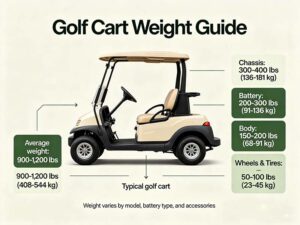
Standard Weight Ranges for Golf Carts
Generally speaking, the weight of a golf cart is not a fixed value; rather, it varies depending on the specific model, battery type, and structural configuration.
1. Basic Two-Seater Golf Carts
This is the most common standard model, typically used on golf courses:
Vehicle Weight: Approx. 400–550 kg (880–1210 lbs)
Features:
Simple structure
Seats 2 passengers
Primarily used for light loads and short-distance travel
2. Four-Seater Golf Carts
Suitable for use in resorts, residential communities, or private households:
Vehicle Weight: Approx. 500–750 kg (1100–1650 lbs)
Features:
Longer body
Increased seating capacity
Enhanced stability
3. Six-Seater and Multi-Purpose Golf Carts
Frequently used in scenic areas, for hotel shuttle services, or for campus transportation:
Vehicle Weight: Approx. 750–1000 kg (1650–2200 lbs)
Features:
Larger and sturdier frame
Higher load-bearing capacity
Often equipped with a reinforced chassis
4. Cargo-Type Golf Carts
Used for short-distance transport within factories or logistics facilities:
Vehicle Weight: Approx. 700–1200 kg (1540–2640 lbs)
Features:
Designed with a rear bed or cargo box
High load-bearing capacity
Functions primarily as a utility vehicle

Key Factors Influencing Golf Cart Weight
The significant variations in golf cart weight primarily stem from the following factors:
1. Battery Type (The Most Critical Factor)
Currently, there are two main types of power systems:
Lead-Acid Batteries
Heavier weight
Typically account for 150–300 kg of the total vehicle weight
Lithium Batteries
Lighter weight
Can reduce battery weight by 30%–50%
Enhance driving range and efficiency
ODREAMCAR also offers lithium-powered versions, which can significantly reduce overall vehicle weight and boost performance.
2. Frame Material
Different materials directly impact both weight and structural strength:
Steel Frame: Heavier but more robust
Aluminum Alloy Frame: Lighter but higher in cost
Hybrid Structure: Balances both strength and lightweight design
3. Seating Capacity
The more seats a cart has, the larger its body size:
2-Seater → Lightest
4-Seater → Moderate weight
6–8 Seater → Significantly heavier
4. Additional Features/Accessories
Common accessories that add to the weight include:
Enclosed Cab/Canopy
Windshield
Rear Trunk/Cargo Box
Air Conditioning System (on select high-end models)
Reinforced Suspension System
These features can add anywhere from 50 to 200 kg to the vehicle’s weight.
Electric vs. Gas-Powered Golf Carts: A Weight Comparison
Average Weight: 400–900 kg
Weight is concentrated in the battery system
Operate more quietly and smoothly
Average Weight: 500–1000 kg
Engine structure is more complex
Higher maintenance costs
Overall, electric vehicles in the modern market are lighter, more energy-efficient, and more aligned with environmental trends.
The Significant Impact of Golf Cart Weight
Many users believe that “weight is just a number,” but in reality, it directly affects vehicle performance.
1. Driving Stability
Heavier Weight → Greater wind resistance
Lighter Weight → More agile, though stability may be slightly reduced
2. Hill-Climbing Capability
Appropriate weight helps enhance traction:
Too Light: Prone to slipping
Moderate: More stable when climbing hills
3. Range (Electric Models)
Increased Weight → Faster battery consumption
Lightweight Design → Extended driving range
4. Shipping and Logistics Costs
For export customers:
Weight directly impacts ocean freight costs
It also affects container loading capacity (per 40HQ or 20GP container)
ODREAMCAR Golf Cart: Weight-Optimized Design
As a professional manufacturer, ODREAMCAR places a strong emphasis on achieving a “balance between weight and performance” in its product design.
1. Lightweight Frame Design
By utilizing high-strength steel and employing structural optimization techniques, we reduce redundant weight while ensuring uncompromising safety.
2. Upgraded Lithium Battery System
Compared to traditional lead-acid batteries, our system offers:
Lighter weight
Higher energy density
Longer service life
3. Modular Structural Design
This design allows customers to select specific modules based on their requirements:
Seating modules
Cargo box modules
Enclosed roof modules
Enabling “on-demand configuration without adding unnecessary weight.”
4. Multi-Scenario Adaptability
ODREAMCAR models are designed to serve a wide range of environments:
Golf courses
Resorts and hotels
Industrial parks
Scenic area shuttles
Private residential communities
We provide the optimal combination of weight and configuration tailored to the specific needs of each distinct setting.
Should you consider weight when purchasing a golf cart?
The answer is: Absolutely—but weight should not be your sole consideration.
It is far more important to take a comprehensive approach, evaluating factors such as:
Intended usage scenarios
Passenger capacity requirements
Power system specifications
Battery type
Whether the vehicle needs to be street-legal
For example:
Golf Courses → Lighter and more agile
Scenic Area Transport → Heavier and more stable
Industrial Applications → Greater emphasis on load-bearing capacity
The weight of a golf cart typically ranges from 400 kg to 1,200 kg, varying significantly depending on the specific configuration and intended application. Weight not only impacts transportation costs but also directly influences the vehicle’s stability, driving range, and overall user experience.
ODREAMCAR is dedicated to providing global customers with intelligently lightweight designs and high-performance electric golf cart solutions, ensuring that every model achieves the optimal balance between weight, safety, and performance.
FAQ
Q1: How much does a golf cart typically weigh?
A: Most standard golf carts weigh between 400 kg and 750 kg (880–1650 lbs), depending on seating capacity, battery type, and configuration.
Q2: What affects the weight of a golf cart?
A: Key factors include battery type (lead-acid or lithium), frame material, number of seats, and additional features such as cargo boxes or enclosed cabins.
Q3: Are electric golf carts heavier than gas models?
A: Not always. Electric models may be heavier due to batteries, but modern lithium battery systems can significantly reduce overall weight compared to traditional lead-acid setups.
Q4: Does golf cart weight affect performance?
A: Yes. Heavier carts usually offer better stability, while lighter carts may have improved energy efficiency and longer driving range.
Q5: What is the weight range of ODREAMCAR golf carts?
A: ODREAMCAR golf carts typically range from 400 kg to over 1000 kg, depending on model type, seating capacity, and customization options.