
As golf carts gradually expand from golf courses into communities, tourist attractions, and short-distance transportation, a key question is gaining increasing attention:
Do you need a license to drive a golf cart?
As a professional golf cart manufacturer, Odreamcar must clearly state:
👉 Whether a license is required does not depend on the vehicle itself, but rather on “usage scenario + national regulations + vehicle attributes”.
This article will systematically analyze the underlying logic of this issue from the perspective of manufacturers and the global market, and will compare the policy differences in different countries in detail.
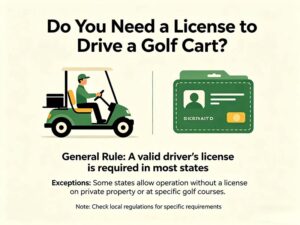
Key takeaway: Whether a driver’s license is needed depends on “where you drive.”
Globally, regulations can be summarized in one sentence: Private areas generally do not require a driver’s license, while public roads generally do.
Specifically:
✔ Situations where a driver’s license is not required:
Inside golf courses
On private land (farms, factories)
Within gated communities
In these scenarios, golf carts are considered “non-motorized vehicles or site equipment,” and most countries do not mandate a driver’s license.
✔ Situations where a driver’s license is required:
Driving on public roads
Defined as a low-speed vehicle (LSV)
Commercial operations (such as rentals, shuttles)
For example, in the United States, most states explicitly require:
👉 A valid driver’s license is required whenever driving on public roads.

United States: The Most Typical (And Most Complex) Rules
The United States is one of the countries with the most widespread use of golf carts, and its regulations are representative.
1. Basic Rules
Private Areas: Generally no driver’s license required.
Public Roads: A driver’s license is required in most states.
Also required:
Age limit is usually 14–16 years or older.
Vehicles must meet LSV standards.
2. Special Circumstances
Some states (such as Florida) allow:
Driving without a license on low-speed community roads.
Driving without a license (under limited conditions).
This illustrates a key point: The United States does not have uniform rules, but rather a “state + city two-tiered management” system.
Europe: License Required, but Stricter Classification
In Europe, golf carts are typically classified as:
L6e / L7e Light Vehicles
This means:
A corresponding driver’s license (such as an AM or B class license) is required.
European characteristics:
Higher degree of regulatory uniformity
Mandatory insurance and registration
Stricter vehicle safety requirements
However, in the following scenarios:
Hotels
Golf courses
Industrial parks
A driver’s license is usually not required.
China: Generally No Driver’s License Required (But Still Not Allowed on Public Roads)
In China, the legal status of golf carts is very clear:
They are classified as “course vehicles only”
They are not allowed on public roads
Conclusion: No driver’s license required (because they cannot be driven on public roads)
They are for use only in closed areas
This is also the biggest difference between China and Europe and the United States.
Japan: Strict regulations, equivalent to the logic of motor vehicles
In Japan: A valid driver’s license is required to drive any vehicle on public roads
Including low-speed vehicles
Therefore: If a golf cart is allowed on the road (in very rare cases), a driver’s license is required.
Middle East and Southeast Asia: Flexible but Not Uniform
For example:
✔ Middle East (UAE, Saudi Arabia)
Private communities: No driver’s license required
Public roads: Usually require a driver’s license
✔ Southeast Asia (Thailand, Vietnam, etc.)
Inside tourist areas: No driver’s license required
Designated roads: May require a permit or driver’s license
Characteristics: Rules are more “scenario-dependent” than nationally standardized legislation.
Why such a large difference?
From a manufacturer’s perspective, the fundamental reason lies in three levels:
1. Different vehicle attributes:
Sports vehicle: Equipment
LSV: Motor vehicle
2. Different road attributes:
Private roads: Lax management
Public roads: Strict regulation
3. Different regulatory systems:
US: Local autonomy
Europe: Unified standards
Asia: More restrictions
👉 These three factors combined result in a high degree of fragmentation in global regulations.
Odreamcar Manufacturer’s Recommendations (Practical Guide)
If customers are concerned about “whether a driver’s license is required,” we recommend determining this logically:
✔ Step 1: Confirm the Usage Scenarios
On the golf course only → No license required
On public roads → Continue to determine
✔ Step 2: Confirm Vehicle Type
Regular golf cart → Usually not allowed on public roads
LSV (Low-Speed Vehicle) → Requires a driver’s license
✔ Step 3: Check Local Regulations
👉 Must Confirm:
Whether it is allowed on public roads
Whether a driver’s license is required
Whether registration is required
Odreamcar Vehicle Recommendations (Compliance-Oriented)
Based on different regulatory environments, we recommend:
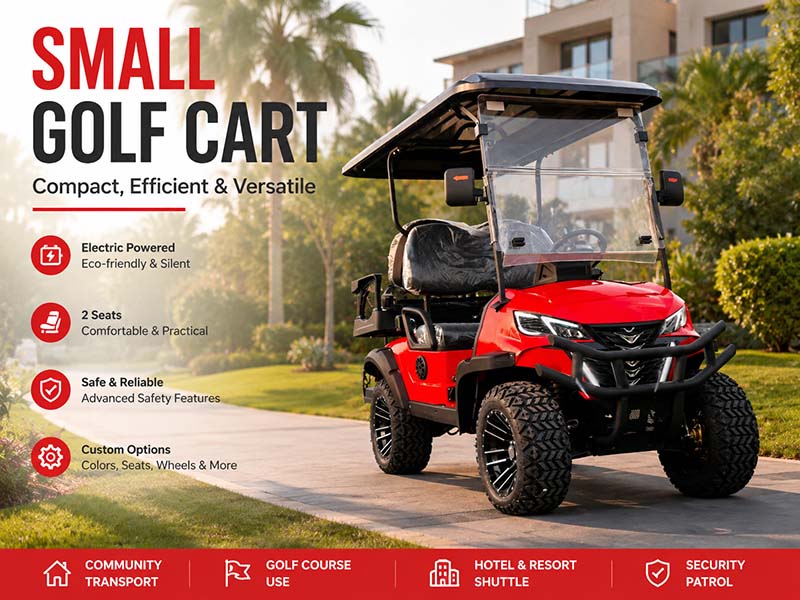
1. 2-Seat Electric Golf Cart (For On-Site Use)
No driver’s license required
Lowest cost
Suitable for most global scenarios
2. 4-Seat Street Legal Golf Carts
Road use supported
Complies with US/partial European regulations
Driver’s license required
3. Commercial 6 seater electric golf cart
For scenic areas/hotels
Usually no driver’s license required (closed environments)
Customizable safety features available
The fundamental logic behind driver’s license issues:
From a manufacturer’s perspective, we offer the most authoritative summary: Whether a driver’s license is needed depends not on “whether it’s a golf cart,” but on “whether it’s used on public transportation.”
In private spaces → Usually not required
On public roads → Almost always required
FAQ – Do You Need a License to Drive a Golf Cart?
1. Do you need a license to drive a golf cart?
It depends on where you drive. In private areas such as golf courses, farms, or resorts, a license is usually not required. However, on public roads, most countries require a valid driver’s license.
2. Can I drive a golf cart on public roads without a license?
In most regions, no. Once a golf cart is allowed to enter public roads or is classified as a Low-Speed Vehicle (LSV), a driver’s license is typically required.
3. Can children drive a golf cart?
In private areas, some places allow underage driving under supervision. However, on public roads, minimum age and valid driving license rules must be followed according to local laws.
4. Do all golf carts require registration?
No. Standard golf carts used in closed areas usually do not require registration. Only road-legal LSV golf carts may need registration, insurance, and compliance with local regulations.
5. What happens if I drive a golf cart without a license where it is required?
If used illegally on public roads, it may result in fines, penalties, or vehicle confiscation depending on local traffic laws.
6. How do I know if my golf cart needs a license?
Check three factors:
Where you will use it (private vs public area)
Whether it is road-legal (LSV or not)
Local government regulations