

With the widespread adoption of golf carts across various settings—including resorts, hotels, residential communities, industrial parks, and campuses—an increasing number of users are turning their attention to the core component of the vehicle’s powertrain: the battery. Currently, the two most common types of golf cart batteries on the market are lithium batteries and lead-acid batteries. For purchasers, the choice of battery type not only impacts vehicle performance but also directly affects long-term operating costs, maintenance efficiency, and the overall user experience.
So, when comparing lithium versus lead-acid golf cart batteries, which option is truly the better choice? This article provides a comprehensive analysis from multiple perspectives—including driving range, lifespan, maintenance costs, safety features, and user experience—to help you make a more informed and rational purchasing decision.
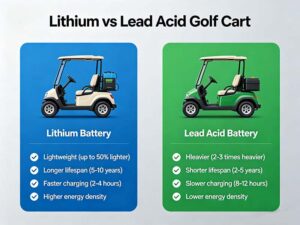
What Are Lithium Batteries and Lead-Acid Batteries?
A lithium battery is a modern battery system utilizing lithium-ion technology, characterized by high energy density, lightweight construction, rapid charging capabilities, and a long service life. Currently, they are widely employed in new energy vehicles, high-end electric vehicles, and high-performance golf carts.
Lead-acid batteries, conversely, represent a traditional battery technology with a long history of application; they are characterized by lower costs and mature technology, and for a considerable period, they served as the standard power source for golf carts.
Although both types can serve as power sources for golf carts, they exhibit distinct differences in practical application.

Endurance Comparison
Under equivalent voltage conditions, lithium batteries typically possess a higher energy density; consequently, they can store more electrical energy and provide a longer operating range.
For instance, a golf cart equipped with a lithium battery can typically sustain full-day operations, making it particularly well-suited for high-frequency usage scenarios such as scenic area shuttles, hotel transport, and community patrols.
In contrast, lead-acid batteries offer a relatively shorter operating range and lower discharge efficiency; furthermore, their endurance capacity tends to gradually diminish as usage time increases.
Comparison Summary:
Lithium Batteries: Longer operating range, higher efficiency
Lead-Acid Batteries: Average operating range, faster performance degradation
Battery Lifespan Comparison
Battery lifespan is a critical factor in procurement costs.
The cycle life of lithium batteries typically exceeds 2,000 cycles, with high-quality products reaching even beyond 4,000 cycles. This means that, under normal usage conditions, they can remain in service for many years.
The cycle life of lead-acid batteries typically ranges between 500 and 1,000 cycles, necessitating earlier replacement when subjected to frequent use.
Comparison Summary:
Lithium Batteries: Long lifespan, low replacement frequency.
Lead-Acid Batteries: Shorter lifespan, higher long-term costs.
Charging Speed Comparison
Lithium batteries offer the advantage of rapid charging, allowing them to fully recharge within a relatively short timeframe—a feature that significantly boosts vehicle utilization efficiency.
For settings requiring high-frequency vehicle dispatch—such as hotels, tourist attractions, and industrial parks—rapid charging translates directly into reduced downtime and enhanced operational efficiency.
In contrast, lead-acid batteries typically require longer charging times and recover more slowly following deep discharge.
Comparison Summary:
Lithium Batteries: Fast charging, high efficiency
Lead-Acid Batteries: Slow charging, disrupts operational workflow
Maintenance Cost Comparison
Lead-acid batteries typically require regular maintenance—such as replenishing water, checking electrolyte levels, and cleaning corroded terminals—as failure to do so can negatively impact their lifespan and performance.
Lithium batteries, conversely, are virtually maintenance-free; they require no fluid replenishment or frequent inspections, making their day-to-day management significantly easier.
For corporate clients managing a fleet of multiple vehicles, the difference in maintenance costs and labor requirements is particularly pronounced.
Comparison Summary:
Lithium Batteries: Maintenance-free; saves time and effort.
Lead-acid Batteries: Requires maintenance; entails high management costs.
Weight vs. Driving Experience
Lithium batteries are significantly lighter than lead-acid batteries, weighing less even at equivalent capacities. This translates to a lower overall vehicle weight, resulting in greater agility, smoother acceleration, and reduced stress on the tires and chassis.
Lead-acid batteries are heavier; they increase the vehicle’s load and can negatively impact handling performance.
**Comparison Summary:**
Lithium Batteries: Lighter, more agile
Lead-Acid Batteries: Heavier, impacts performance
Safety Performance Comparison
Modern, high-quality lithium batteries are typically equipped with a Battery Management System (BMS) that monitors parameters such as temperature, voltage, and current in real time, thereby enhancing safety.
Lead-acid battery technology is mature; however, they may generate gases during the charging process and therefore require a well-ventilated environment.
Provided that products from reputable manufacturers are used and operated according to proper guidelines, both types of batteries can be utilized safely; nevertheless, high-end lithium batteries offer distinct advantages in terms of intelligent safety protection.
Procurement Cost Comparison
Lead-acid batteries have a lower initial purchase cost; therefore, customers with limited budgets typically prioritize lead-acid solutions.
Lithium batteries require a higher upfront investment; however, due to their longer lifespan, minimal maintenance requirements, and lower energy consumption, they often prove to be the more advantageous choice when considering the total long-term cost of ownership.
Comparison Summary:
Priority: Short-term Budget — Lead-acid batteries
Priority: Long-term Return on Investment — Lithium batteries
Recommended Applications
Scenarios Suitable for Lithium Batteries:
Golf Carts for Residential Communities
Golf Carts for Campuses / Schools
Electric Utility Vehicles for Industrial Use
Scenarios Suitable for Lead-acid Batteries:
Projects with Limited Budgets
Vehicles with Low Usage Frequency
Temporary Project Requirements
Small-scale Fleet Operations
Comprehensive Recommendation
When choosing between Lithium vs Lead Acid Golf Cart batteries, there is no absolute answer. The best choice depends on your budget, usage frequency, and long-term planning.
| Requirement Type | Recommended Choice |
| Low Initial Budget | Lead Acid Battery |
| Lower Long-Term Cost | Lithium Battery |
| High-Frequency Operation | Lithium Battery |
| Low-Frequency Use | Lead Acid Battery |
| Premium Projects | Lithium Battery |
| Easy Maintenance | Lithium Battery |
Overall, with continuous technological advancements and gradually decreasing prices, lithium golf carts are rapidly becoming the mainstream choice, especially in commercial operations and high-end projects where their advantages are more evident.
Choosing a golf cart is not only about appearance and seating capacity, but also about the long-term value provided by the battery system. Lithium batteries represent higher efficiency, lower maintenance, and longer lifespan, while lead acid batteries are more suitable for budget-focused purchasing decisions.
If you are looking for a high-quality golf cart solution, it is recommended to choose the most suitable battery configuration based on your actual application needs, helping you achieve the best return on investment.
FAQ
Q1: Which is better for a golf cart, lithium or lead acid battery?
Lithium batteries offer longer lifespan, faster charging, lighter weight, and lower maintenance, while lead acid batteries have a lower upfront cost.
Q2: How long does a lithium golf cart battery last?
A quality lithium battery can last 2,000–4,000+ charge cycles, depending on usage and maintenance conditions.
Q3: How long does a lead acid golf cart battery last?
Lead acid batteries usually last around 500–1,000 charge cycles and may need replacement sooner with frequent use.
Q4: Are lithium batteries worth the higher price?
Yes. Although the initial cost is higher, lithium batteries often save money over time through longer life, better efficiency, and lower maintenance.
Q5: Do lithium golf cart batteries charge faster?
Yes. Lithium batteries typically charge much faster than lead acid batteries, reducing downtime and improving vehicle availability.
Q6: Which battery is better for resorts, hotels, and commercial fleets?
Lithium batteries are ideal for high-use commercial environments because they provide reliable performance, long runtime, and minimal maintenance.