
In the use and maintenance of golf carts, the battery is not only the core of the power system but also a key component determining the overall operating cost and performance. As an Electric and Gas Golf Cart Manufacturer, we’ve found in serving global customers that “How long do golf cart batteries last?” is one of the most pressing questions during the purchasing and usage phases.However, the answer isn’t a single number but depends on multiple factors, including battery type, usage frequency, maintenance methods, and environmental conditions. This article will systematically analyze the underlying logic of golf cart battery life from a manufacturer’s perspective, helping users make more informed choices.
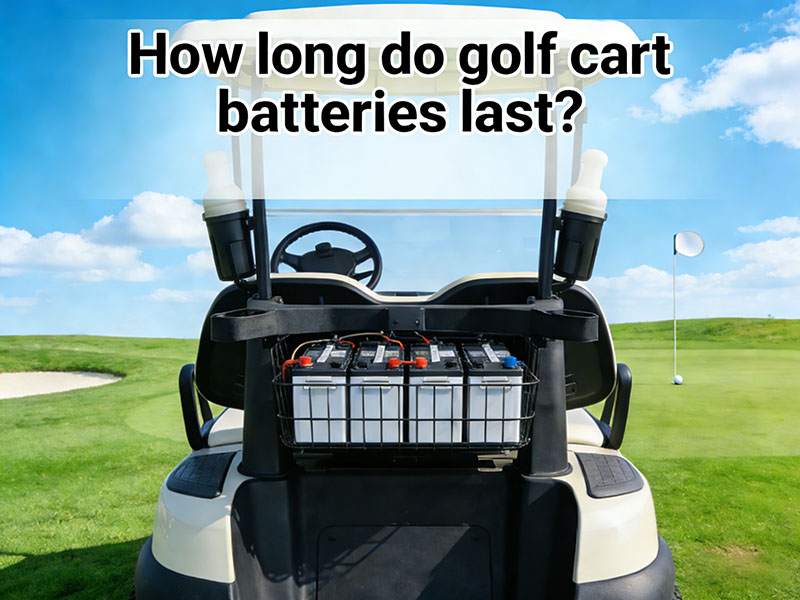
How long do golf cart batteries last?
Under industry standards, the typical lifespan of different battery types is as follows:
Lead-Acid Battery: Approximately 3–6 years
Lithium Battery: Approximately 8–12 years
In terms of charge-discharge cycles:
Lead-Acid Battery: Approximately 500–1,000 cycles
Lithium Battery: Approximately 2,000–5,000 cycles
Conclusion: Lithium batteries typically have a lifespan 2–4 times longer than lead-acid batteries, but have a higher initial cost.

Key Factors Affecting Battery Life
Based on Odreamcar’s manufacturing experience, battery life is not simply a matter of “how many years it will last,” but is determined by several key variables:
1. Usage Frequency and Deep Discharge
Frequent deep discharge (completely depleting the battery before recharging) significantly shortens battery life, especially for lead-acid batteries.
Recommendations:
Keep the battery level above 20%.
Avoid completely depleting the battery before recharging.
2. Charging Habits
Incorrect charging methods are one of the main causes of premature battery aging.
Common problems include:
Overcharging
Not charging for extended periods
Using an incompatible charger.
Odreamcar recommends:
Use the original manufacturer’s smart charger and recharge the battery promptly after each use.
3. Ambient Temperature
Batteries are extremely sensitive to temperature:
High Temperature (>35°C): Accelerates battery aging
Low Temperature (<0°C): Reduces discharge efficiency
Ideal Operating Temperature: 20°C–25°C
4. Maintenance Level
Especially for lead-acid batteries, maintenance directly determines the upper limit of their lifespan.
Key maintenance actions include: Regularly adding distilled water; cleaning electrodes to prevent corrosion; and checking voltage consistency. Lithium batteries, on the other hand, are essentially maintenance-free, which is one of their major advantages.
In-depth Comparison of Different Battery Types
Within the Odreamcar product portfolio, we primarily offer two battery solutions: lead-acid and lithium-ion. Below is a core comparison from a manufacturer’s perspective:
1. Lead-Acid Battery
Advantages:
Low initial cost
Mature technology
Suitable for budget-sensitive customers
Disadvantages:
Shorter lifespan
Requires maintenance
Heavier weight
Suitable scenarios:
Short-term use, low-frequency needs, projects with limited budgets
2. Lithium-ion Battery
Advantages:
Long lifespan (up to 10 years or more)
Fast charging speed
Lightweight design
Maintenance-free
Disadvantages:
Higher initial cost
Suitable scenarios:
High-frequency use (e.g., scenic spots, hotels), long-term investment projects
3. Cost Comparison (Long-Term Perspective)
Although lithium-ion batteries are more expensive, from a “total lifecycle cost” perspective:
Lithium-ion batteries offer better value for money
Reasons include:
Fewer replacement cycles
Lower maintenance costs
Higher energy efficiency
How to extend golf cart battery life?
Based on Odreamcar’s global customer data, we’ve summarized a set of practical recommendations:
Proper charging
Charge after each use
Avoid overcharging or undercharging
Avoid extreme environments
Avoid storing in direct sunlight or extreme cold
Regular checks
Check electrolyte levels for lead-acid batteries
Check all battery connections
Use responsibly
Avoid overloading
Avoid prolonged operation at full load
Odreamcar Golf Cart Recommendations (Battery Optimization Solutions)
Based on different customer needs, we recommend the following high-performance models:
1. Classic 2-Seat Electric Golf Cart (Lead-Acid Version)
Economical and practical
Suitable for golf courses and short trips
Optimal cost control
Recommended for: First-time buyers
2. Upgraded 4 Seater Lithium Battery Electric Golf Car
Longer battery life
Maintenance-free
Suitable for both home and commercial use
Recommended for: Community and resort operators
3. Commercial 6 Passenger Lithium Battery Electric Golf Cart
High-intensity design
Long-life battery system
Supports all-day operation
Recommended for: Scenic spots, hotels, and parks
Battery lifespan is essentially a combination of usage habits and technology selection.
The question “How long do golf cart batteries last?” can be summarized as follows: In the short term, it depends on usage habits; in the long term, it depends on battery type.
If you prioritize low cost → lead-acid batteries are sufficient.
If you prioritize long-term value → lithium batteries are superior.
As a manufacturer, Odreamcar always advises customers to choose the appropriate solution based on their actual usage scenarios, rather than simply comparing prices.
Final recommendation: If your golf cart is used daily and runs for long periods, choose a lithium battery solution directly; if it is only used occasionally, lead-acid batteries remain a reliable and economical choice.